Analytical Reasoning Is Back in CLAT 2027: Question Types, Traps & How to Master It
Analytical Reasoning Is Back in CLAT 2027: Question Types, Traps & How to Master It
Analytical Reasoning was sidelined in CLAT's 2020 pattern overhaul. CLAT 2027 is bringing it back into sharp focus — and most aspirants are not ready.
The Logical Reasoning section carries 28–32 marks in CLAT. Analytical Reasoning questions — seating arrangements, blood relations, order-and-ranking, syllogisms, and critical reasoning — now account for a significant slice of that count. These are not reading comprehension questions you can wing on instinct. They are structured puzzles with one correct answer and four trap options. The aspirants scoring AIR under 500 treat them like a scoring machine. Everyone else treats them like guesswork.
This guide covers every CLAT 2027 analytical reasoning question type, the exact traps examiners set, and the step-by-step method to solve them at speed.
Start your CLAT 2027 prep the right way. Get structured daily GK + reasoning practice — CLAT Tribe 2027 Starter Kit → clattribe.com/clat-2027-starter-kit
What Is Analytical Reasoning in CLAT 2027?
Analytical Reasoning tests your ability to draw logical conclusions from a given set of conditions — without any prior knowledge of the subject. The exam gives you a passage or a set of statements, lays down specific rules or constraints, and asks you to determine what follows.
In CLAT 2027's Logical Reasoning section, analytical reasoning appears in two forms:
Passage-based analytical reasoning: A short paragraph sets up a scenario — say, six people sitting in a row with specific constraints. Questions follow asking about positions, relationships, or what must or cannot be true.
Standalone analytical reasoning: A direct set of statements (syllogisms, logical sequences, cause-effect) with questions testing what follows logically.
Both formats reward one thing: the ability to build a clean mental or paper model of the given information and query it accurately under time pressure.
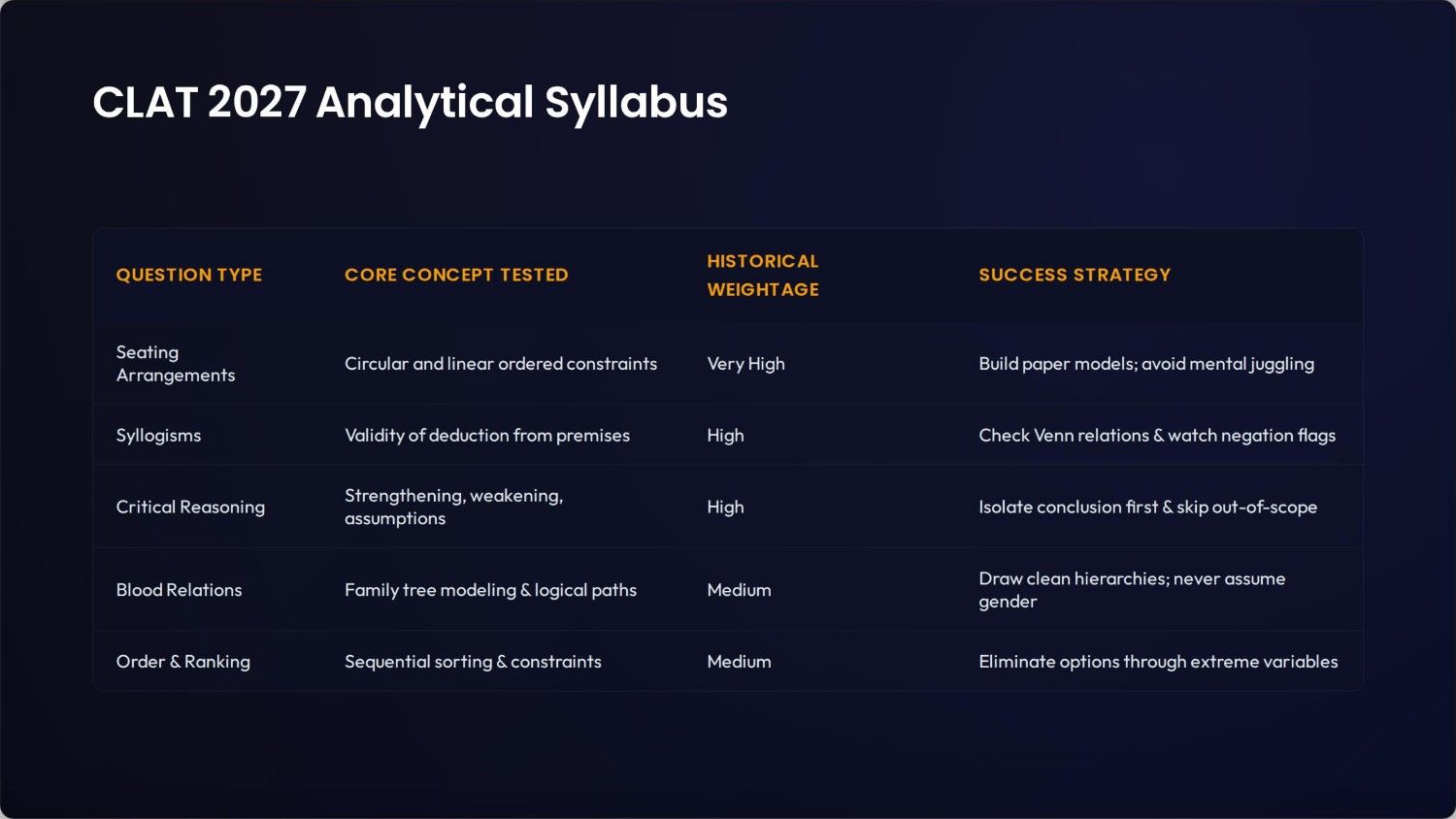
Every Question Type You Will Face
| Question Type | What It Tests | Frequency in CLAT |
|---|---|---|
| Seating Arrangements | Circular or linear ordering with constraints | High |
| Blood Relations | Family tree construction from given clues | Medium |
| Order & Ranking | Positions in a sequence with relative clues | Medium |
| Syllogisms | Validity of conclusions from two premises | High |
| Logical Sequences | Identifying the pattern in a series | Medium |
| Critical Reasoning | Strengthen / weaken / assumption questions | High |
| Cause and Effect | Determining which statement causes another | Low–Medium |
| Course of Action | Evaluating appropriate responses to a situation | Low |
Critical Reasoning and Syllogisms are the highest-frequency types in recent CLAT papers. Seating Arrangements, while time-consuming, often deliver 3–4 questions from a single setup — making them high-value if you crack the base model correctly.
The Biggest Traps Examiners Set
Trap 1: The "Could Be True" vs "Must Be True" confusion. This is the most common source of wrong answers in CLAT analytical reasoning. "Could be true" means possible under at least one valid arrangement. "Must be true" means true in every valid arrangement. These are fundamentally different questions. Aspirants who miss the distinction pick an answer that works but isn't always true.
Trap 2: The redundant clue. In seating or ordering puzzles, one clue is often completely derivable from the others. Examiners include it to slow you down and make the set look more complex than it is. Identify redundant clues early — don't waste time trying to "use" every statement.
Trap 3: The negation flip in syllogisms. CLAT syllogism options often include statements like "Some A are not B" placed alongside "No A is B." These are not the same conclusion. Aspirants who move fast confuse partial negation with universal negation and pick the wrong option consistently.
Trap 4: Circular reasoning in Critical Reasoning. In strengthen/weaken questions, one wrong option will actually address a different conclusion than the one stated. It looks compelling — it's just answering the wrong question. Always re-read the exact conclusion before evaluating each option.
Trap 5: Assuming information not given. In blood relation or seating questions, aspirants infer gender, direction, or position from clues that only imply it. If the question says "Priya is to the left of Rohan," that tells you nothing about which direction either is facing. Build only what the clues explicitly support.
Sharpen your reasoning with 1,200+ CLAT-verified flashcards — built by the team behind IPMAT AIR 1 & AIR 7. CLAT Tribe Smart Flashcards → clattribe.com
A Step-by-Step Method to Solve Analytical Reasoning Questions
Step 1 — Read all clues before drawing anything. Never draw your model after reading clue 1. Read every constraint first. Some clues eliminate entire configurations upfront. Start modelling only once you have the full picture.
Step 2 — Identify absolute clues first. An absolute clue fixes one element definitively: "A sits at the extreme left." These are your anchor points. Place them first. Everything else hangs off them.
Step 3 — Use elimination, not construction. Rather than building the one correct arrangement, eliminate impossible arrangements. This is faster and less error-prone. CLAT's time pressure rewards elimination speed.
Step 4 — Mark "must be true" and "could be true" before reading the questions. After building your model, scan your arrangement and note: what is fixed in every valid scenario? What can vary? This pre-labelling means you answer questions in seconds rather than rebuilding logic for each one.
Step 5 — For Critical Reasoning — isolate the conclusion first. Underline the exact conclusion in the passage before reading the options. Strengthen/weaken/assumption questions test your relationship to that specific conclusion — not the passage overall. Aspirants who underline the conclusion answer 30–40% faster and more accurately.
Beginner to Pro: Practice Roadmap for CLAT 2027
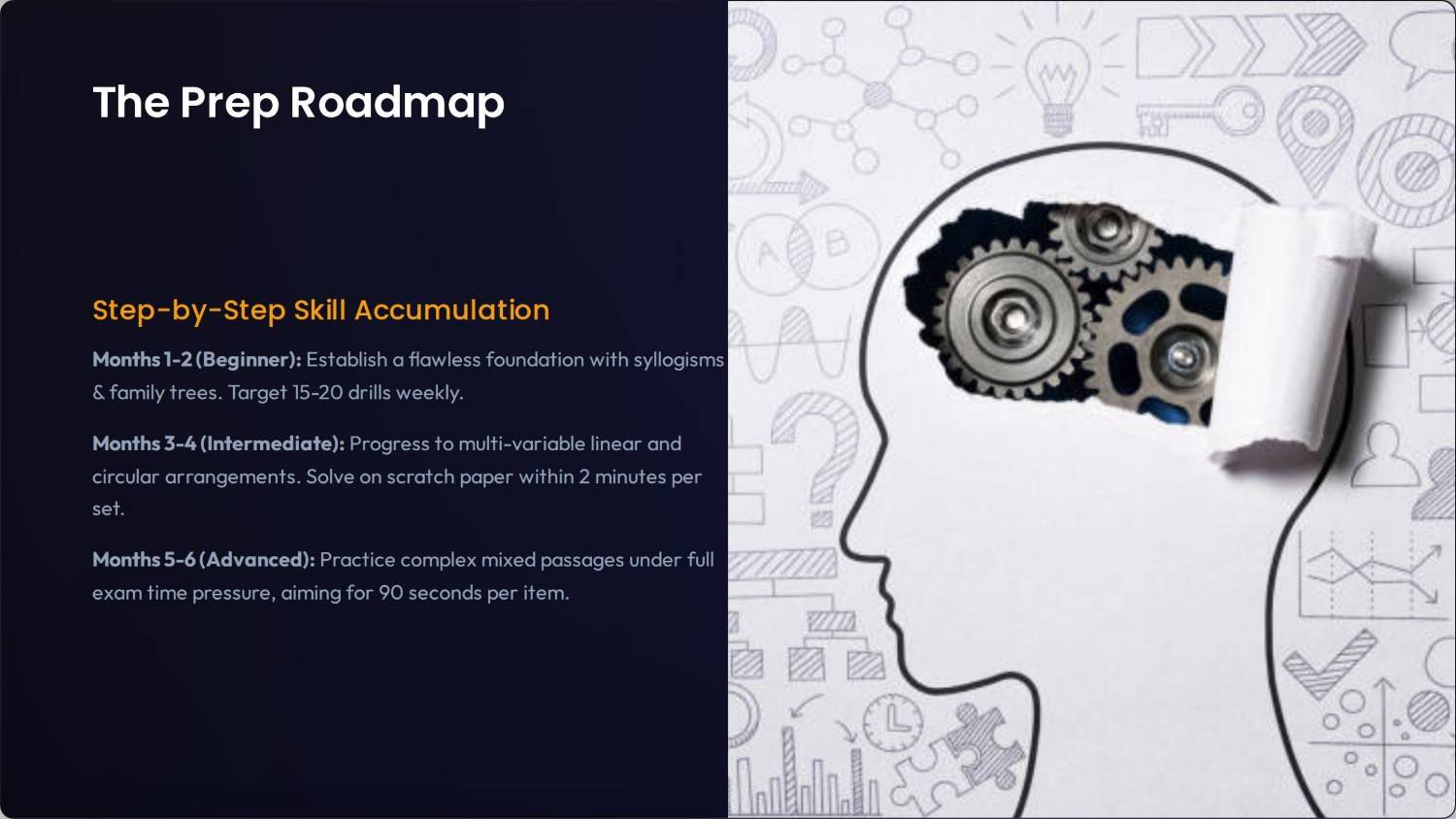
| Stage | Focus | Weekly Target |
|---|---|---|
| Beginner (Months 1–2) | Syllogisms + Blood Relations only; master the basics | 15–20 questions/week |
| Intermediate (Months 3–4) | Seating Arrangements + Order-Ranking; timed at 2 min/set | 40–50 questions/week |
| Advanced (Months 5–6) | Critical Reasoning; mixed-type sets; 90 sec/question | 70–80 questions/week |
| Pro (Final 6 weeks) | Full CLAT mock papers; target 75%+ accuracy in Logical Reasoning | Full mocks |
One practical rule for the intermediate stage: never solve a seating arrangement set in your head. Paper models — even rough diagrams — reduce error rates by 40–50% for most aspirants. The 20 extra seconds spent drawing saves 60 seconds of retracing wrong assumptions.
FAQs: Analytical Reasoning in CLAT 2027
Is Analytical Reasoning a separate section in CLAT 2027?
No. Analytical Reasoning questions appear within the Logical Reasoning section, which carries 28–32 marks. CLAT 2027 does not have a standalone Analytical Reasoning section, but the question types described above form a significant portion of the Logical Reasoning score.
Which analytical reasoning question type is hardest?
Critical Reasoning is the most challenging for most aspirants because it requires precise identification of argument structure — conclusion, premise, assumption — and is easily confused by trap options that address a different conclusion. Seating Arrangements are the most time-consuming.
How many questions come from Analytical Reasoning in CLAT?
Based on CLAT 2024 and 2025 patterns, roughly 12–18 marks within Logical Reasoning involve analytical reasoning formats — seating, syllogisms, and critical reasoning combined.
Do I need to draw diagrams for seating arrangement questions?
Yes, always. Aspirants who solve seating arrangements mentally make significantly more errors under exam pressure. A 20-second rough diagram is faster and more accurate than 90 seconds of mental juggling.
How is CLAT 2027 Logical Reasoning different from earlier years?
CLAT 2020–2025 leaned heavily on passage-based reasoning, reducing direct puzzle formats. CLAT 2027 is expected to reintroduce analytical reasoning question types more prominently alongside passage-based questions — making it critical to practise both formats.
What's the fastest way to improve in Analytical Reasoning?
Start with syllogisms — they have the shortest feedback loop and build the logical precision needed for all other question types. Then move to seating arrangements. Do not attempt Critical Reasoning seriously until your syllogism accuracy is above 80%.
Conclusion
Analytical Reasoning in CLAT 2027 is not a section you can revise the week before the exam. It rewards structured practice, clean mental models, and the discipline to follow a method when time is tight and options look convincing.
The aspirants who break AIR 500 are not smarter. They practise seating arrangements until diagrams take 15 seconds. They know the difference between "must be true" and "could be true" without thinking. They underline the conclusion in every Critical Reasoning question before reading a single option.
Build that precision now. Eight months is enough time — if you start with the right system.
Access CLAT Tribe's free CLAT 2027 Starter Kit — structured resources built by the team behind IPMAT AIR 1 & AIR 7. Start free → clattribe.com/clat-2027-starter-kit