
CLAT vs AILET 2027: Exam Pattern, Difficulty, Colleges — Which Should You Target?
Listen to this article
CLAT vs AILET 2027: Exam Pattern, Difficulty, Colleges — Which Should You Target?
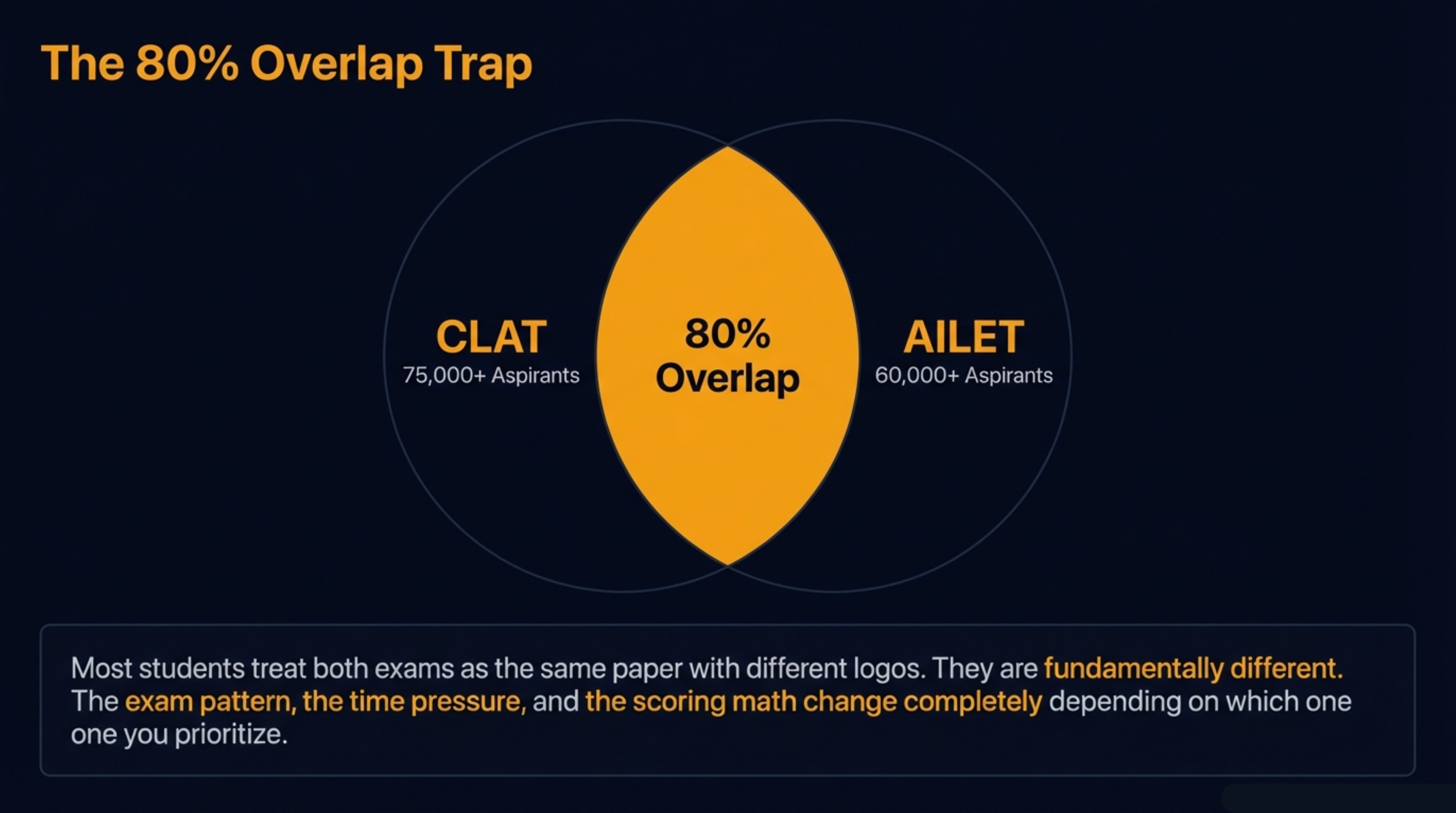
75,000 aspirants will sit for CLAT. Another 60,000 will attempt AILET. The overlap between both groups? Roughly 80%. Yet most students treat both exams as the same paper with different logos. They're not. The exam pattern is different, the time pressure is different, and the scoring math changes completely depending on which one you prioritise. This post breaks down every difference — pattern, difficulty, cutoffs, colleges — so you can make a strategic call on where to invest your prep hours.
Already building your GK base? Get CLAT Tribe's daily GK capsules → clattribe.com

What Is the CLAT 2027 Exam Pattern?
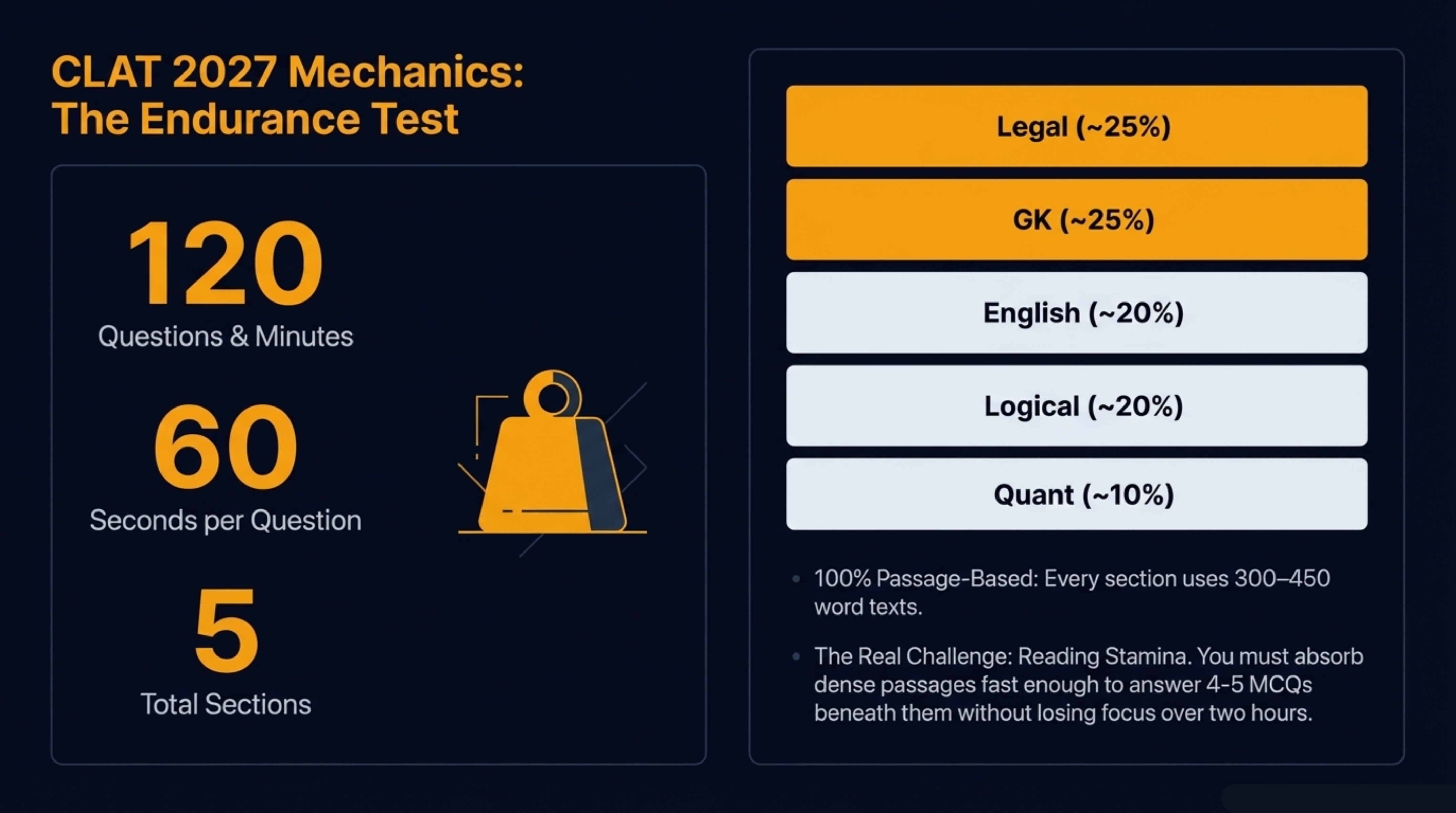
CLAT 2027 is a 120-question, 120-mark paper with a duration of 2 hours (120 minutes). It is conducted in offline (pen-and-paper) mode by the Consortium of NLUs.
There are five sections in CLAT:
| Section | Approx. Questions | Approx. Marks | Weightage |
|---|---|---|---|
| English Language | 22–26 | 22–26 | ~20% |
| Current Affairs & GK | 28–32 | 28–32 | ~25% |
| Legal Reasoning | 28–32 | 28–32 | ~25% |
| Logical Reasoning | 22–26 | 22–26 | ~20% |
| Quantitative Techniques | 10–14 | 10–14 | ~10% |
Each correct answer scores +1 mark. Each incorrect answer deducts 0.25 marks. Unanswered questions carry zero penalty.
The entire paper is passage-based. English, Current Affairs, Legal Reasoning, and Logical Reasoning sections use passages of 300–450 words followed by 4–5 MCQs per passage. Quantitative Techniques also uses short data sets rather than standalone calculation questions.
This means CLAT is a reading-intensive exam. You get exactly 60 seconds per question, but the real challenge is absorbing dense passages fast enough to answer the questions beneath them.
Get access to CLAT Starter Kit 2027
What Is the AILET 2027 Exam Pattern?
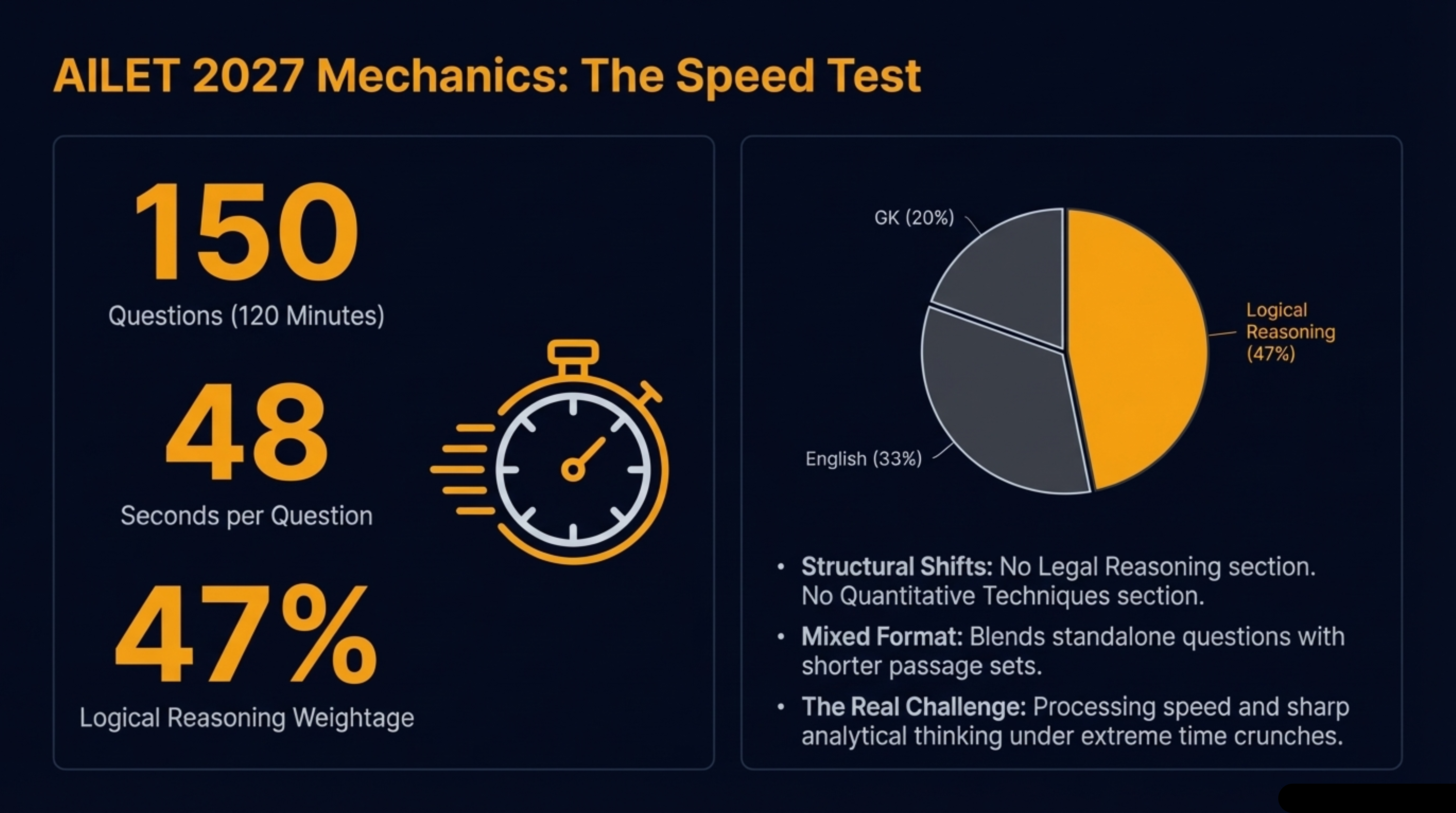
AILET (All India Law Entrance Test) is conducted by National Law University, Delhi — independently, outside the CLAT consortium. The 2027 UG paper will have 150 questions worth 150 marks in 120 minutes.
Here's the section breakdown:
| Section | Questions | Marks | Weightage |
|---|---|---|---|
| English Language | 50 | 50 | 33% |
| General Knowledge & Current Affairs | 30 | 30 | 20% |
| Logical Reasoning | 70 | 70 | 47% |
Marking scheme: +1 for correct, −0.25 for incorrect, 0 for unattempted.
Three things stand out immediately. First, AILET has no Legal Reasoning section. Second, there's no Quantitative Techniques section. Third, Logical Reasoning alone accounts for nearly half the paper.
AILET's questions are not passage-based in the same way CLAT's are. The Logical Reasoning section includes a mix of standalone questions and shorter passage sets, which changes the kind of speed you need.
CLAT vs AILET 2027: Side-by-Side Comparison
Here's a direct comparison table that captures every structural difference:
| Parameter | CLAT 2027 | AILET 2027 |
|---|---|---|
| Conducting Body | Consortium of NLUs | NLU Delhi |
| Total Questions | 120 | 150 |
| Total Marks | 120 | 150 |
| Duration | 120 minutes | 120 minutes |
| Time per Question | 60 seconds | 48 seconds |
| Mode | Offline (pen & paper) | Offline (pen & paper) |
| Sections | 5 | 3 |
| Legal Reasoning | Yes (~25%) | No |
| Quantitative Techniques | Yes (~10%) | No |
| Logical Reasoning Weight | ~20% | ~47% |
| English Weight | ~20% | ~33% |
| GK/Current Affairs Weight | ~25% | ~20% |
| Passage-Based Format | Fully passage-based | Mixed (standalone + passage) |
| Negative Marking | −0.25 per wrong answer | −0.25 per wrong answer |
| Colleges Covered | 24 NLUs | NLU Delhi only |
| Approx. Applicants | 75,000+ | 60,000+ |
| Approx. UG Seats | 4,000+ (across 24 NLUs) | 110 |
The time-per-question gap is the single most underestimated difference. AILET gives you 48 seconds per question — 20% less time than CLAT. If your mock test strategy doesn't account for this, you'll feel the crunch on exam day.
Which Exam Is Harder — CLAT or AILET?
This depends on what kind of "hard" you mean.
CLAT is harder in terms of reading load. The fully passage-based format means you're reading 20–25 dense passages across five sections. Fatigue is real. Students who read slowly or lose focus after 60 minutes tend to struggle in the final two sections. Building reading stamina is non-negotiable for CLAT.
AILET is harder in terms of time pressure and competition ratio. You get 48 seconds per question. The Logical Reasoning section alone has 70 questions — that's nearly half the paper — and the questions range from analytical reasoning to critical reasoning puzzles that demand sharp thinking under pressure. On top of that, roughly 60,000 students compete for just 110 BA LLB seats at NLU Delhi. That's a ratio of about 545:1. Compare that with CLAT's 75,000 applicants for 4,000+ seats across 24 NLUs — roughly 19:1.
Difficulty of individual questions: AILET questions tend to be more direct but faster-paced. CLAT questions are embedded in passages, so you need to locate the answer within the text before choosing an option. Aspirants with strong reading comprehension often find CLAT more natural. Aspirants with strong logical reasoning and speed often perform better in AILET.
The practical takeaway: CLAT tests endurance and comprehension. AILET tests speed and reasoning under pressure. You need to know which challenge suits you better.
CLAT 2027 Colleges: All 24 NLUs
CLAT scores are accepted by 24 National Law Universities across India. Here are the top-tier NLUs with their CLAT 2026 General Category approximate closing ranks:
| NLU | Location | CLAT 2026 Gen. Closing Rank (Approx.) |
|---|---|---|
| NLSIU | Bangalore | ~100 |
| NALSAR | Hyderabad | ~170 |
| WBNUJS (NUJS) | Kolkata | ~300 |
| NLU Jodhpur | Jodhpur | ~400 |
| NLIU | Bhopal | ~450 |
| GNLU | Gandhinagar | ~520 |
| RMLNLU | Lucknow | ~650 |
| HNLU | Raipur | ~800 |
| NUALS | Kochi | ~900 |
| CNLU | Patna | ~1,100 |
Cutoffs are based on CLAT 2026 Round 1 allotment data and are approximate. Actual closing ranks shift across counselling rounds.
Beyond the top 10, there are 14 more NLUs including DNLU Jabalpur, DSNLU Visakhapatnam, MNLU Mumbai, MNLU Nagpur, MNLU Aurangabad, TNNLS Tiruchirappalli, DBRANLU Sonipat, and others. For aspirants scoring between AIR 1,000 and 3,500, these NLUs offer strong five-year BA LLB programmes with growing placement records.
The diversity of options is CLAT's biggest advantage. Even if you miss the top 5 NLUs, you still have 19 more institutions to get admitted to — all through the same exam.
AILET 2027 College: NLU Delhi
AILET leads to exactly one institution — National Law University, Delhi. And that's not a weakness. NLU Delhi consistently ranks among the top 3 law schools in India, alongside NLSIU Bangalore and NALSAR Hyderabad.
AILET 2026 cutoff data (BA LLB):
| Category | Closing Rank (Round 3) | Approx. Score Required |
|---|---|---|
| General | ~71 | 119–121 / 150 |
| OBC | ~105 | 110–115 / 150 |
| SC | ~180 | 95–100 / 150 |
| ST | ~250 | 85–90 / 150 |
NLU Delhi offers 110 BA LLB seats, with 50 seats in the general category. You need to score roughly 80% of the total marks to secure a general category seat. That's 120+ out of 150 — with a −0.25 penalty for each wrong answer.
NLU Delhi's placement record, its location in the national capital, and its proximity to the Supreme Court, High Court, and top law firms make it a high-value target. If NLU Delhi is your first-choice NLU, AILET preparation deserves dedicated attention — not just "whatever overlaps with CLAT."
Syllabus Overlap: How Much Prep Transfers Between CLAT and AILET?
The overlap is roughly 80–85%, which is why most serious aspirants prepare for both exams simultaneously. Here's where the overlap works — and where it breaks:
Full overlap (prepare once, use twice):
- English Language (reading comprehension, grammar, vocabulary)
- General Knowledge and Current Affairs
- Core Logical Reasoning (syllogisms, arrangements, blood relations, coding-decoding)
CLAT-specific sections (no AILET equivalent):
- Legal Reasoning — passage-based legal principle questions. This is unique to CLAT and carries ~25% weightage. You need dedicated prep for this.
- Quantitative Techniques — basic maths (percentages, ratios, averages, data interpretation). Carries ~10% weightage. Most students can cover this with 2–3 weeks of focused practice.
AILET-specific demand (different skill level needed):
- Logical Reasoning at 47% weightage — AILET asks nearly double the number of LR questions compared to CLAT. You need to go deeper: critical reasoning, strengthening-weakening arguments, and assumption-based questions feature more heavily in AILET.
GK and Current Affairs is tested in both exams but the treatment differs. CLAT frames GK within passages — you read a passage about a recent event and answer inference-based questions. AILET tends to ask more direct, factual GK questions. This means CLAT rewards understanding of context, while AILET rewards recall of facts.
Building a GK system that works for both? CLAT Tribe's 1,200+ smart flashcards cover factual recall and context-based understanding → clattribe.com/our-courses
CLAT vs AILET: Which Should You Target?
This isn't a one-size answer. It depends on your profile, your strengths, and how many NLU options you want to keep open.
Target CLAT as your primary exam if:
- You want access to 24 NLUs, not just one
- Your reading speed and comprehension are strong
- You prefer passage-based questions where you can locate answers in text
- You're comfortable with Legal Reasoning as a section
- You want a wider safety net — even at AIR 2,000, you'll get a solid NLU seat
Target AILET as your primary exam if:
- NLU Delhi is your top-choice and you're willing to go all-in for 110 seats
- Your Logical Reasoning is significantly stronger than your Legal Reasoning
- You perform better under time pressure with faster, more direct questions
- You're confident of scoring 80%+ on a 150-mark paper
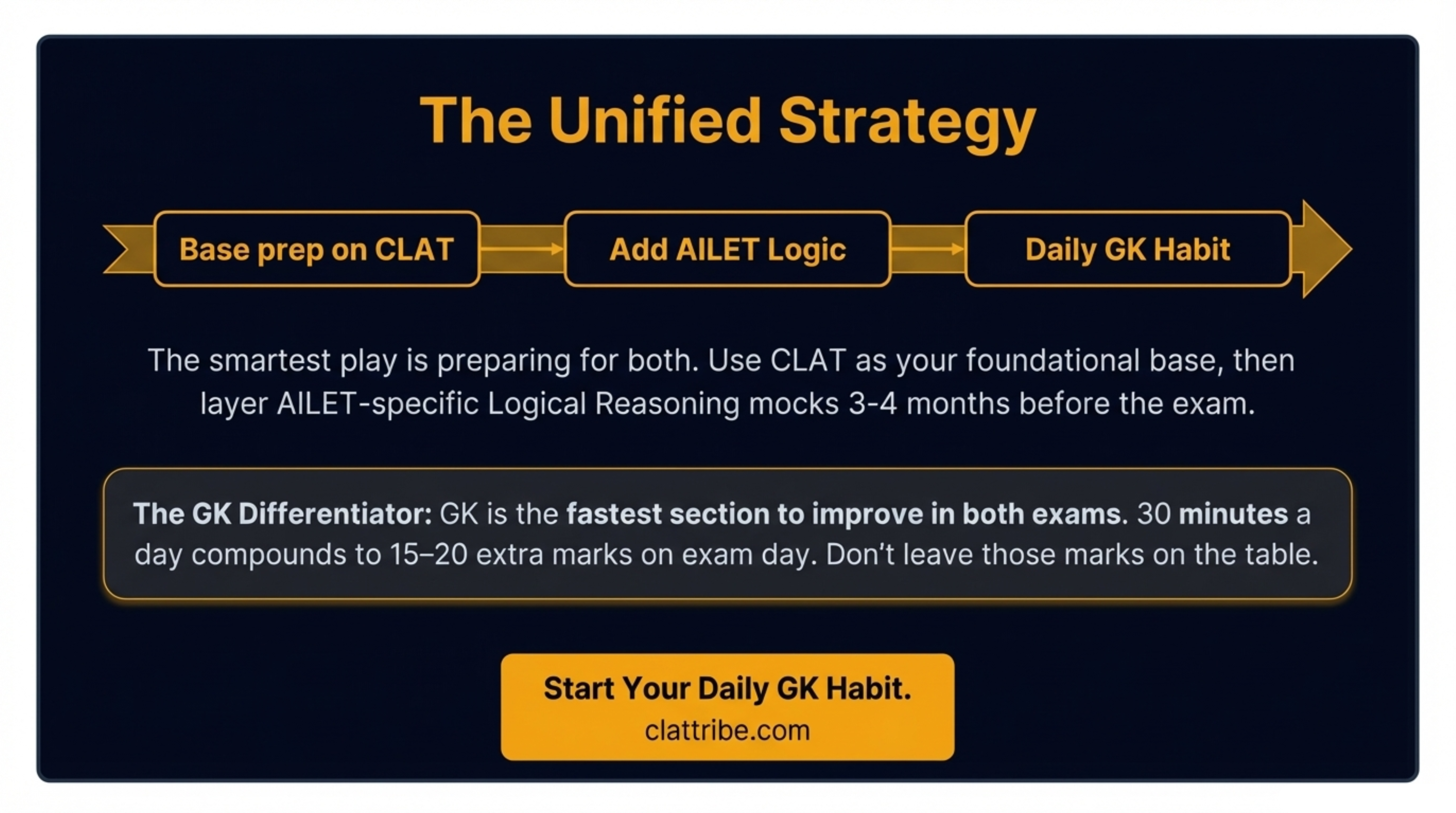
The smart play for most aspirants: prepare for both. Use CLAT as your base prep since it covers more sections. Then add AILET-specific Logical Reasoning practice (especially critical reasoning and analytical puzzles) starting 3–4 months before the exam. Allocate at least 2 full-length AILET mocks per month alongside your CLAT mocks once you're within 6 months of exam day.
How to Prepare for CLAT and AILET 2027 Together
Here's a practical split of how your weekly prep hours should look if you're targeting both exams:
| Prep Area | Weekly Hours | Covers |
|---|---|---|
| English Comprehension & Vocabulary | 4–5 hours | Both CLAT + AILET |
| Current Affairs & GK (daily capsule) | 3–4 hours (30 min/day) | Both CLAT + AILET |
| Logical Reasoning (basic + advanced) | 5–6 hours | Both (with extra depth for AILET) |
| Legal Reasoning (CLAT-specific) | 3–4 hours | CLAT only |
| Quantitative Techniques | 1–2 hours | CLAT only |
| Mock Tests (alternating CLAT/AILET format) | 3–4 hours | Both |
Current Affairs and GK is the one section that shows up in both exams and is the fastest section to improve with a structured system. Most aspirants spend 30 minutes a week on it. The ones who crack top NLUs spend 30 minutes a day. That gap of ~3 hours per week across 6 months compounds into 15–20 extra marks on exam day.
Start your daily GK habit now → CLAT Tribe's CLAT 2027 Starter Kit (Free)
FAQs: CLAT vs AILET 2027
Is AILET harder than CLAT?
AILET is harder in terms of competition ratio (545:1 vs ~19:1) and time pressure (48 seconds vs 60 seconds per question). CLAT is harder in terms of reading volume and the addition of Legal Reasoning and Quantitative Techniques sections. Neither exam is universally "harder" — it depends on your strengths.
Can I appear for both CLAT and AILET 2027?
Yes. CLAT and AILET are conducted by separate bodies on separate dates. There's no rule preventing you from appearing for both. In fact, most serious law aspirants register for both exams to maximise their NLU options.
Does AILET have Legal Reasoning?
No. AILET does not have a dedicated Legal Reasoning section. Its three sections are English Language (50 marks), General Knowledge (30 marks), and Logical Reasoning (70 marks). Legal Reasoning is unique to CLAT.
What score do I need to get into NLU Delhi through AILET?
Based on AILET 2026 data, General category candidates needed approximately 119–121 marks out of 150 (about 80%) to secure a BA LLB seat at NLU Delhi. The closing rank was around 71 in the third merit list.
How many NLUs accept CLAT scores?
24 National Law Universities across India accept CLAT scores for admission to their BA LLB and LLM programmes. NLU Delhi is the only NLU that does not accept CLAT scores — it conducts AILET separately.
Is the GK syllabus the same for CLAT and AILET?
The topics overlap significantly — both test current affairs, static GK, legal awareness, and major national/international events. The difference is in the question format: CLAT frames GK within passages requiring inference, while AILET leans towards direct factual recall questions.
Should a Class 11 student start preparing for AILET separately?
Not yet. In Class 11, focus on building a strong base across English, GK, and Logical Reasoning — all three transfer directly to both exams. Start AILET-specific LR practice (critical reasoning, advanced puzzles) from Class 12 onward, roughly 8–10 months before the exam.
Which exam has more scope — CLAT or AILET?
CLAT offers broader scope with 24 NLUs and 4,000+ seats. AILET offers a focused shot at one of India's top 3 law schools with 110 seats. If "scope" means options, CLAT wins. If "scope" means prestige-per-seat, AILET holds its own.
The Bottom Line
CLAT and AILET are not the same exam with different branding. They test different skill mixes, run at different speeds, and lead to different sets of institutions. The smartest approach is to prepare for both — using CLAT as your foundation and layering AILET-specific skills on top.
Your GK and Current Affairs prep transfers fully between both exams. That's 20–25% of each paper where you can build a scoring advantage with just 30 minutes of structured daily practice. The students who treat GK as an afterthought lose marks in both exams. The ones who build a system around it — capsules, flashcards, daily revision — gain 15–20 marks that their peers simply leave on the table.
Toh ab faisla tumhara hai — CLAT, AILET, ya dono. Prep smart, prep daily.
Build your GK system for CLAT + AILET 2027 → CLAT Tribe's CLAT 2027 Starter Kit (Free)