CLAT 2027 Notification Out: Dates, Registration & What's New
CLAT 2027 Notification Out: Dates, Registration & What's New
Every year, roughly 80,000 students compete for around 3,000 seats across 26 NLUs. The gap between securing NLSIU and missing every NLU on your list is often a matter of weeks — weeks lost because a student didn't track the notification, missed the registration window, or prepared for the wrong pattern. The Consortium of NLUs has now moved on CLAT 2027, and the details change more than just your calendar. This post breaks down the confirmed dates, the registration process, the fee structure, and the pattern changes the Consortium's expert committee has been building toward. Read it once, and you won't need to check five different sites again this year.
Already prepping for CLAT 2027? Get CLAT Tribe's daily GK capsules → clattribe.com
When Is the CLAT 2027 Notification and Exam Date?
The CLAT 2027 notification is expected around mid-to-late July 2026, with the official PDF and detailed information bulletin to follow on consortiumofnlus.ac.in. The exam itself is expected to be held on Sunday, 6 December 2026, continuing the Consortium's pattern of holding CLAT on the first Sunday of December, in offline pen-and-paper mode.
This timeline matters more than it looks. A December exam date means your prep window from notification to test day is under five months. Students who start their GK and Legal Reasoning revision only after the notification drops are already behind the ones who started building their base in July.
| Milestone | Expected Date |
|---|---|
| Notification release | Mid-to-late July 2026 |
| Registration opens | 1 August 2026 |
| Registration closes | 31 October 2026 |
| Correction window | Early November 2026 |
| Admit card release | Late November 2026 |
| CLAT 2027 exam date | 6 December 2026 |
| Result declaration | Late December 2026 |
Treat these as the working dates until the Consortium confirms the final bulletin — CLAT Tribe will flag any shift the moment it's official.
CLAT 2027 Registration: Fees, Process, and Deadlines
Registration for CLAT 2027 is expected to open on 1 August 2026 and close on 31 October 2026, with applications submitted entirely online through consortiumofnlus.ac.in. There is no late-fee window in most years — miss the deadline, and you sit out the cycle entirely, so this isn't a date to leave for the last week.
The application process itself is straightforward, but small errors here cost students real time during the correction window:
- Register on consortiumofnlus.ac.in with a valid email ID and mobile number
- Fill in personal, academic, and category details
- Upload scanned photograph, signature, and category/disability certificates (if applicable)
- Select your preferred NLUs and programme (UG or PG)
- Pay the application fee online
- Download and save the confirmation page
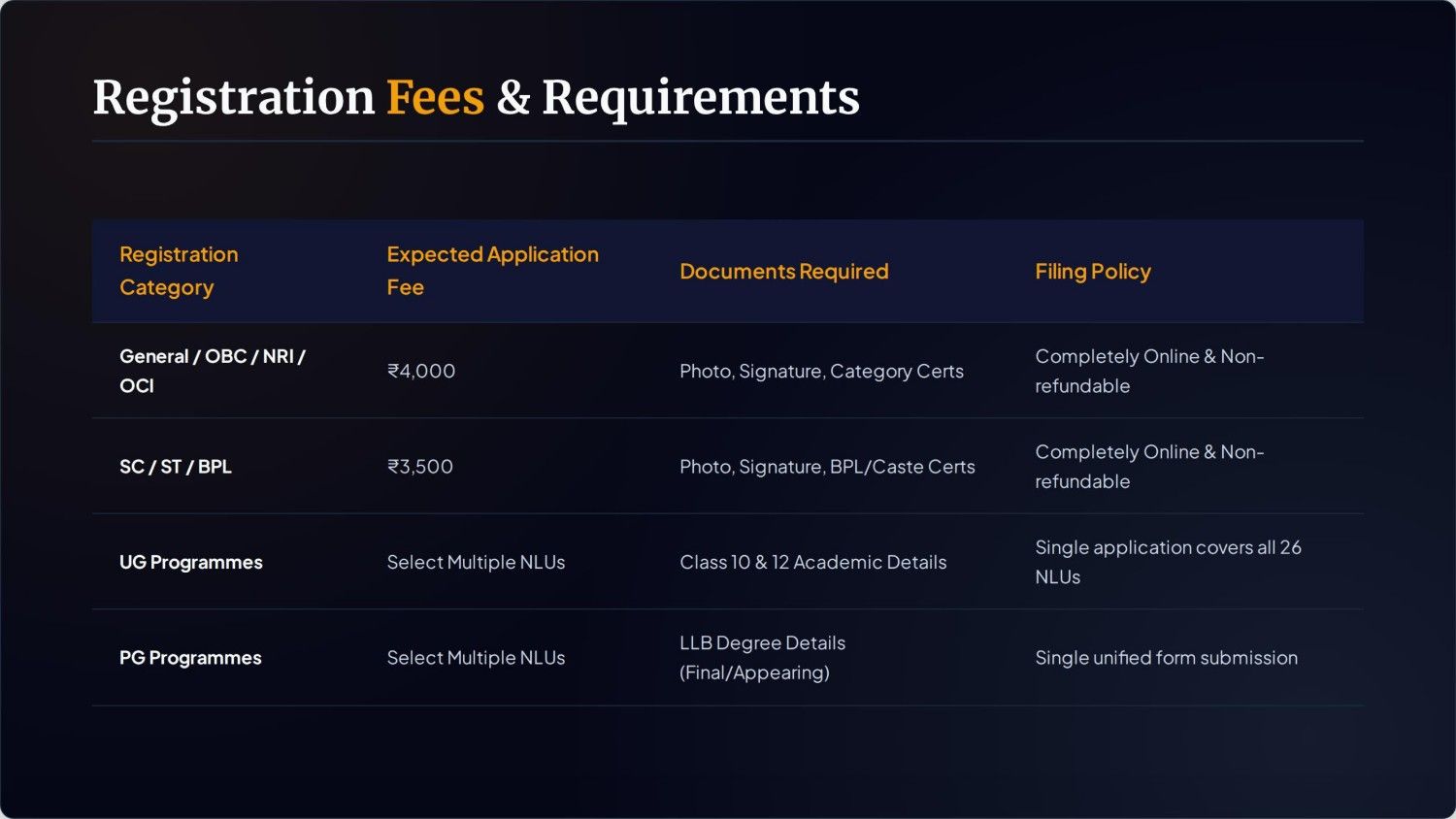
Application fee (expected, based on prior cycles):
| Category | Fee |
|---|---|
| General / OBC / Other | ₹4,000 |
| SC / ST / BPL | ₹3,500 |
Fees are non-refundable and payable via credit card, debit card, or net banking. If you're applying to the UG programme, you can select multiple NLUs under a single application — no need to file separately for each university.
Who Is Eligible for CLAT 2027?
Eligibility for CLAT 2027 UG requires a minimum of 45% marks in Class 12 (40% for SC/ST candidates), with students appearing for their Class 12 exams in 2026 also permitted to apply provisionally. There is no upper age limit for CLAT, a change the Consortium made permanent a few years ago, which means droppers and repeat attempters face no eligibility penalty.
For CLAT PG, candidates need a minimum of 50% marks (45% for SC/ST) in an LLB or equivalent degree. Both UG and PG aspirants must clear the qualifying exam before the counselling process begins, even if results are pending at the time of application.
What's New in CLAT 2027: Pattern and Syllabus Changes
CLAT 2027 is expected to carry the most significant pattern revision in years, driven by a Committee of Independent Academic Experts chaired by Justice Indu Malhotra, with international law academics from Oxford and LSE on board. The committee's brief was clear: make CLAT test the reasoning and reading skills a law career actually demands, not rote memorisation.
Here's what stays and what's shifting:
What's staying the same (for now):
- Five sections: English, Current Affairs & GK, Legal Reasoning, Logical Reasoning, Quantitative Techniques
- 120 questions, passage-based format
- +1 for correct answers, -0.25 for incorrect ones
- Two-hour exam duration
What's likely to change:
- Greater emphasis on reasoning and inference over pure fact recall, especially in Legal Reasoning and Current Affairs
- Passages expected to lean more analytical — closer to editorial and judgment-summary style than straight news reporting
- Possible recalibration of section-wise weightage, with early indications favouring reasoning-heavy sections
- Sharper focus on comprehension under time pressure rather than static GK
CLAT Note: even before the final notification confirms every change, one thing is certain — Current Affairs and GK, worth roughly 25% of your score, will stay the fastest section to improve if you build a daily habit now instead of cramming in November.
The direction is unmistakable: CLAT is moving away from being a test of what you've memorised and toward a test of how well you read, reason, and apply. Students who train on passage-based practice now will adapt faster than those waiting for the syllabus PDF to tell them what to study.
Test yourself now with CLAT Tribe's 1,000+ smart flashcards → clattribe.com/flashcards
CLAT 2027: What Should You Do Right Now?
Waiting for the official notification to start preparing is the single most common mistake CLAT aspirants make. The information bulletin confirms dates and fees — it does not confirm your rank. Here's the sequence that actually moves your score:
- Lock your NLU list now. Know your target cutoffs (NLSIU Bangalore sits around AIR 60–70 for General category; NALSAR around AIR 190–200) so your prep has a clear finish line.
- Start Current Affairs and GK immediately. This is an 18-month rolling section — events from mid-2025 onward are all fair game for a December 2026 exam.
- Register the day the window opens. Don't wait until October; early registration means one less thing on your mind during peak prep months.
- Build a passage-reading habit daily. With the pattern shifting toward reasoning, raw memorisation alone won't carry you through Legal Reasoning or Current Affairs anymore.
Frequently Asked Questions
Is the CLAT 2027 notification out?
The Consortium of NLUs is expected to release the CLAT 2027 notification in mid-to-late July 2026 on consortiumofnlus.ac.in. Until the official PDF is published, treat all dates as expected timelines based on the Consortium's established yearly pattern.
When will CLAT 2027 registration start?
CLAT 2027 registration is expected to open on 1 August 2026 and close on 31 October 2026. Applications are submitted entirely online, and there is typically no provision for late fees once the deadline passes.
What is the CLAT 2027 exam date?
CLAT 2027 is expected to be held on Sunday, 6 December 2026, in offline pen-and-paper mode, continuing the Consortium's practice of scheduling the exam on the first Sunday of December.
What is the application fee for CLAT 2027?
Based on previous cycles, the expected fee is ₹4,000 for General/OBC candidates and ₹3,500 for SC/ST/BPL candidates. Fees are payable online and are non-refundable.
Is CLAT 2027 syllabus changing?
Yes — a Committee of Independent Academic Experts, chaired by Justice Indu Malhotra, has been working on reforms that push CLAT toward more reasoning-based and analytical questions, particularly in Legal Reasoning and Current Affairs, while keeping the five-section, 120-question passage-based structure intact.
Who is eligible for CLAT 2027?
For UG, candidates need at least 45% marks in Class 12 (40% for SC/ST), with no upper age limit. Students appearing for Class 12 in 2026 can also apply provisionally. For PG, a minimum 50% (45% for SC/ST) in LLB or equivalent is required.
How many NLUs accept CLAT 2027 scores?
CLAT scores are accepted by 26 National Law Universities across India, along with several other private and government law schools that use CLAT for admission outside the Consortium's core counselling process.

Conclusion
The CLAT 2027 notification isn't just a date announcement — it's the starting gun for a five-month sprint where every week of delay shows up in your final rank. The dates are set, the fee structure is familiar, and the pattern is shifting toward reasoning over rote recall. None of that changes the fundamentals: GK and Current Affairs remain the fastest section to gain marks in, and the students building that habit today will be the ones reading the January 2027 results with a seat secured, not a repeat attempt planned.
Start building it today: CLAT Tribe's GK Capsules break down every major current affairs event into CLAT-aligned passages and flashcards → clattribe.com/clat-2027-starter-kit