Top 20 Current Affairs Topics for CLAT 2027 | CLAT Tribe
Listen to this article
Top 20 Current Affairs Topics for CLAT 2027
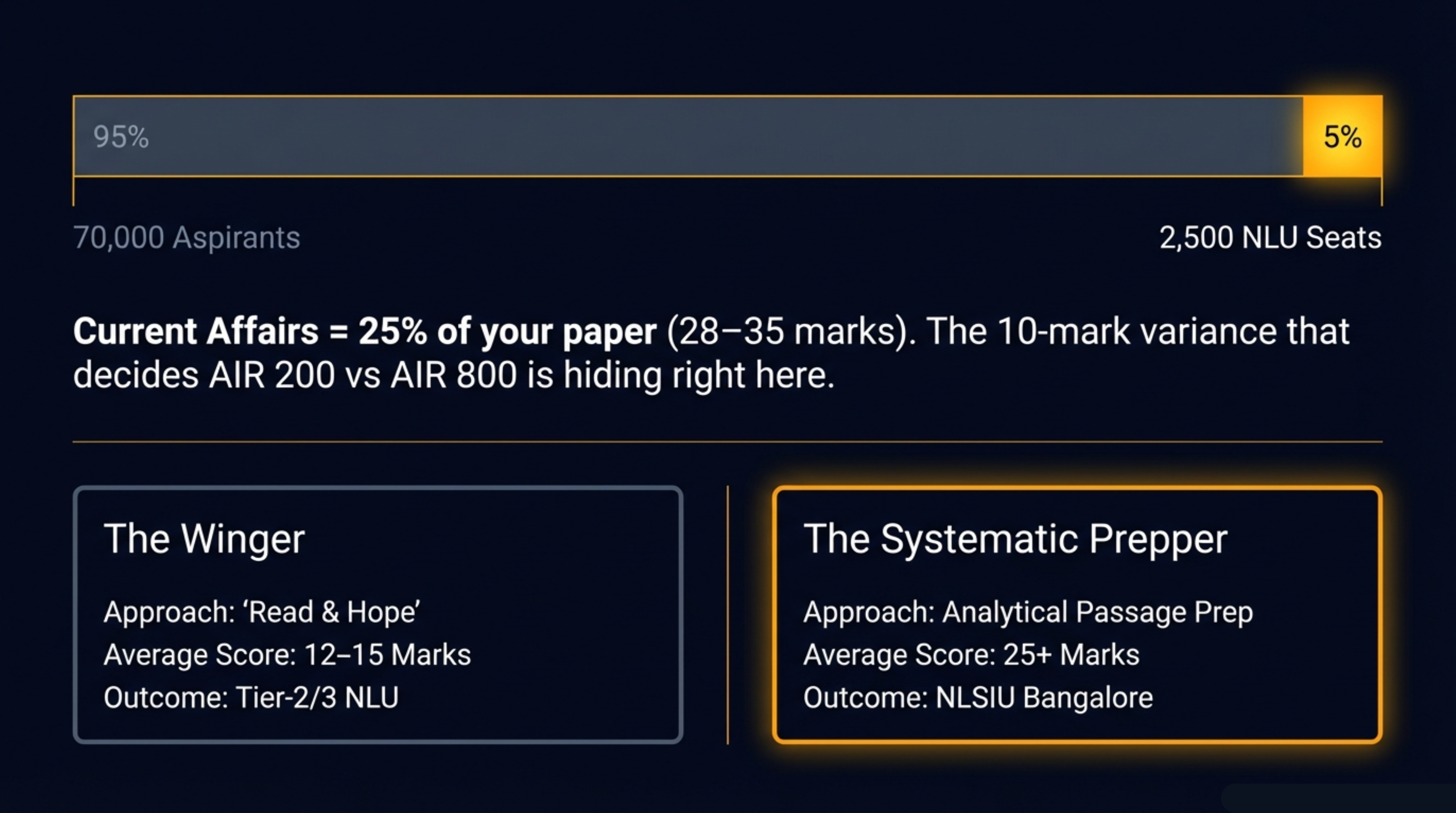
70,000 aspirants. Around 2,500 NLU seats. And a GK section worth 28–35 marks that most students prepare for last — and regret first.
Current Affairs is no longer a "read the newspaper and hope for the best" section. Since 2020, CLAT has shifted almost entirely to passage-based questions drawn from real news stories. That means you don't just need to know facts — you need to understand events in context, connect them to legal principles, and answer inference-based questions under time pressure.
This post breaks down the 20 current affairs topics most likely to appear in CLAT 2027, with the reasoning behind each pick, the kind of passages you can expect, and exactly how to prepare them.
Already prepping? Get CLAT Tribe's daily GK capsules that cover these topics in 30 minutes a day → clattribe.com
Why Current Affairs Decides CLAT Ranks
The GK and Current Affairs section carries roughly 25% of the CLAT paper — that's 28–35 questions out of 120. But here's what the cutoff data tells you: the difference between an AIR 200 and an AIR 800 is often just 8–12 marks. GK is where those marks hide.
Unlike Legal Reasoning or English, where scores cluster tightly, GK has the widest variance across test-takers. Students who prepare systematically score 25+ out of 35. Students who wing it average 12–15. That 10-mark gap is the gap between NLSIU Bangalore and an NLU outside the top 10.
CLAT 2027 will draw passages from events between roughly January 2026 and the month before the exam (expected December 2027). The consortium favours The Hindu, Indian Express, and LiveLaw-style reportage — analytical, not tabloid.
How We Selected These 20 Topics
Every topic on this list meets at least three of four criteria:
- Exam pattern fit: CLAT favours topics that lend themselves to 300–400 word analytical passages with 4–5 inference questions.
- Legal overlap: Topics connected to constitutional law, fundamental rights, international treaties, or legislation are tested disproportionately.
- Sustained media coverage: One-day news stories rarely appear. CLAT picks topics that dominated headlines for weeks or months.
- Past paper precedent: Topics in the same category have appeared in CLAT 2023, 2024, 2025, or 2026.
Topic 1: India's New Criminal Laws — BNS, BNSS, and BSA
The Bharatiya Nyaya Sanhita (BNS), Bharatiya Nagarik Suraksha Sanhita (BNSS), and Bharatiya Sakshya Adhiniyam (BSA) replaced the Indian Penal Code, Code of Criminal Procedure, and Indian Evidence Act respectively, coming into force on 1 July 2024. This is the most significant overhaul of India's criminal justice framework since independence.
Why it will appear in CLAT 2027: The new laws are still being interpreted by courts, debated by legal scholars, and implemented unevenly across states. Expect passages comparing old provisions with new ones, or analysing specific controversial clauses — like community service as punishment, sedition's replacement with Section 152 BNS, or the new timelines for police investigation.
What to study: Key differences between IPC and BNS, new offences introduced, provisions on organised crime and terrorism, and the debate around whether these laws are genuinely reformist or old wine in new bottles.
Topic 2: Digital Personal Data Protection Act and Privacy Rights
India's Digital Personal Data Protection Act, 2023 received notification of its rules in 2025, making it operational. The Act governs how companies and the government collect, store, and process personal data of Indian citizens.
Why it will appear in CLAT 2027: Data privacy sits at the intersection of fundamental rights (Article 21, post-Puttaswamy), technology regulation, and consumer protection. CLAT loves this intersection. Passages could draw from enforcement actions, corporate compliance challenges, or comparisons with the EU's GDPR.
What to study: The rights of data principals, obligations of data fiduciaries, the Data Protection Board's role, exemptions granted to the government, and the ongoing debate about whether the Act adequately protects citizens against state surveillance.
Topic 3: Supreme Court Landmark Judgments (2025–2026)
The Supreme Court delivered over 1,400 judgments in 2025 alone, several of which reshaped constitutional law. Key rulings include: digital accessibility as a fundamental right under Article 21 for persons with disabilities; limits on the Speaker's immunity under the Tenth Schedule (anti-defection law); and the interim ruling on the Waqf (Amendment) Act, 2025.
Why it will appear in CLAT 2027: CLAT consistently tests awareness of recent judicial pronouncements, especially those involving fundamental rights, separation of powers, or federalism. The Court's 2025–2026 term has produced enough material for multiple passages.
What to study: The digital accessibility ruling, the Speaker's power under the anti-defection law, the Waqf Amendment challenge, the Governor's power to withhold bills, and any constitutional bench decisions on religious or minority rights.
Topic 4: The Russia-Ukraine Conflict and Global Security
The Russia-Ukraine war, now in its fourth year, continues to reshape global security architecture. Ceasefire negotiations have gone through multiple phases, with shifting positions from the US, EU, and NATO. The conflict's impact on energy prices, food security, and defence alliances remains a staple of international affairs coverage.
Why it will appear in CLAT 2027: This is a multi-year conflict with deep legal dimensions — international humanitarian law, territorial sovereignty, UN Security Council dynamics, and sanctions regimes. CLAT has tested Russia-Ukraine content in 2023, 2024, and 2025 papers.
What to study: The latest diplomatic positions, India's stance (including at the UN), the humanitarian impact, the role of the International Criminal Court, and how the conflict has affected India's oil imports and defence procurement.
Topic 5: Israel-Hamas Conflict and Middle East Geopolitics
The Israel-Hamas conflict escalated dramatically from October 2023 and has remained a dominant story through 2025–2026, with ceasefire negotiations, humanitarian crises in Gaza, and broader regional implications involving Iran, Hezbollah, and the Abraham Accords.
Why it will appear in CLAT 2027: The conflict raises questions about international humanitarian law, the ICJ's advisory opinion on Palestinian occupation, the role of the UN, and India's diplomatic balancing act. Passage-based questions could draw from ICJ proceedings, UN resolutions, or analytical editorials.
What to study: The ICJ's rulings and South Africa's genocide case, the ceasefire framework, the humanitarian situation, India's voting record at the UN, and the broader impact on West Asian geopolitics.
Topic 6: Climate Change — COP30, COP31, and India's NDCs
COP30 concluded with an agreement to triple adaptation finance to $120 billion per year. The historic High Seas Treaty gained enough ratifications to enter into force in 2026. COP31, scheduled for Antalya, Turkey in late 2026, will scrutinise national climate plans and push for higher ambition.
Why it will appear in CLAT 2027: Climate governance is a CLAT favourite — it blends international law, environmental regulation, India's policy positions, and economic trade-offs. Expect passages from COP outcomes, India's updated Nationally Determined Contributions, or debates on climate justice between developed and developing nations.
What to study: COP30 and COP31 outcomes, the High Seas Treaty, India's net-zero target and NDC progress, carbon market mechanisms, and the tension between economic growth and emission reduction.
Topic 7: Artificial Intelligence Regulation and Ethics
AI regulation has become a front-page policy issue globally. The EU's AI Act became enforceable in stages through 2025. India is formulating its own AI governance framework, and debates around deepfakes, AI in elections, algorithmic bias, and job displacement are intensifying.
Why it will appear in CLAT 2027: AI regulation touches fundamental rights (privacy, free speech, right to work), intellectual property, and criminal law (deepfakes, fraud). CLAT has started testing technology-meets-law topics more frequently since 2022.
What to study: The EU AI Act's risk-based framework, India's approach to AI governance, the deepfake regulation debate, AI's role in judicial decision-making, and ethical concerns around generative AI in education and media.
Topic 8: Uniform Civil Code Debate
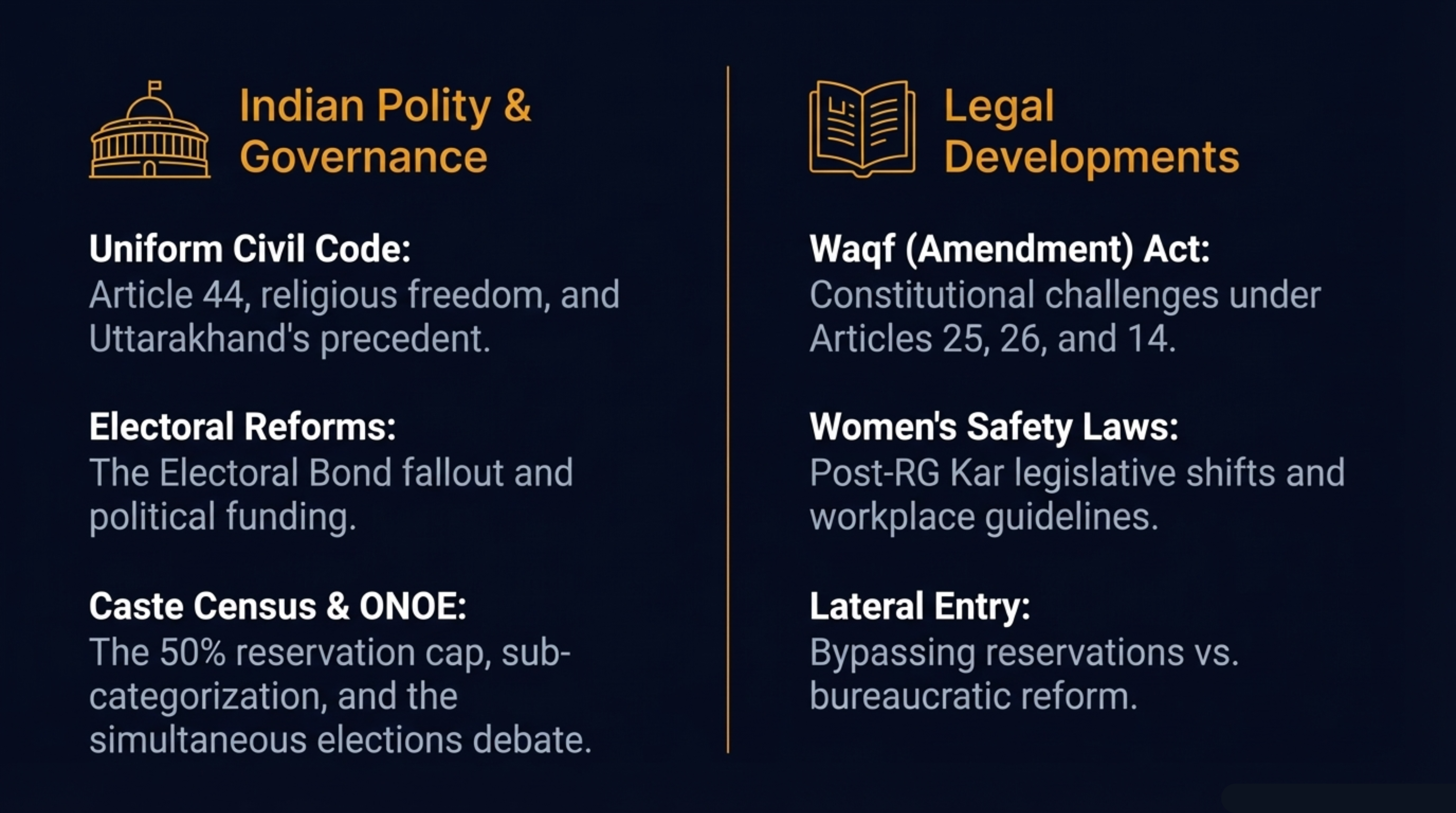
The Uniform Civil Code (UCC) remains one of India's most politically and constitutionally charged topics. Uttarakhand became the first state to implement a UCC in 2025, and the debate around a national UCC has intensified, touching on Article 44 (Directive Principles), religious freedom under Articles 25–26, and federalism.
Why it will appear in CLAT 2027: UCC is a constitutional law goldmine for CLAT paper-setters. It involves Directive Principles vs Fundamental Rights, religious personal laws, gender justice, and Centre-State relations. Passages could be drawn from Uttarakhand's implementation experience, Supreme Court observations, or parliamentary debates.
What to study: Article 44 and its non-justiciable nature, the Shah Bano case legacy, Uttarakhand's UCC provisions, arguments for and against a national UCC, and the Law Commission's stance.
Topic 9: India's G20 Legacy and Multilateral Diplomacy
India's 2023 G20 presidency produced the New Delhi Leaders' Declaration and brought the African Union into the G20. The 2025 G20 Summit in Johannesburg, South Africa — the first on the African continent — carried the theme "Solidarity, Equality, Sustainability." India's role in BRICS expansion, the Quad, and bilateral relations with the US, China, and Russia continues to evolve.
Why it will appear in CLAT 2027: Multilateral diplomacy passages test a student's understanding of India's foreign policy, global governance structures, and economic cooperation frameworks. CLAT has tested G20 and BRICS content in recent years.
What to study: Key outcomes of the Johannesburg G20, BRICS expansion and the new members, India's position on trade and tariffs, the Quad's security agenda, and India-China border diplomacy.
Topic 10: Electoral Reforms and the Electoral Bond Judgment
The Supreme Court struck down the Electoral Bond Scheme in February 2024, calling it unconstitutional. The aftermath — including disclosure of bond purchasers and political recipients — has fuelled a broader debate on electoral transparency, political funding, and the Election Commission's independence.
Why it will appear in CLAT 2027: This judgment is a constitutional law landmark involving the right to information, free and fair elections, and the right to privacy. CLAT is likely to frame passages around the judgment's reasoning, its impact on political funding, or proposed alternatives like state funding of elections.
What to study: The Supreme Court's reasoning (especially the Article 19(1)(a) analysis), the SBI's disclosure of bond data, the debate over alternative funding mechanisms, and the Election Commission's evolving role.
Topic 11: Critical Minerals and Supply Chain Geopolitics
Critical minerals — lithium, cobalt, rare earth elements — have become a geopolitical flashpoint. China controls processing for most critical minerals and introduced new export controls in 2025. India has signed critical mineral agreements with Australia, Argentina, and Chile, and is building domestic processing capacity.
Why it will appear in CLAT 2027: Supply chain geopolitics blends trade law, foreign policy, and economic security. Passages could explore India's "friend-shoring" strategy, the tension between free trade and national security, or the environmental cost of mineral extraction.
What to study: China's rare earth dominance, India's critical mineral partnerships, the role of minerals in EV and defence manufacturing, and the intersection with the WTO's trade rules.
Topic 12: India's Space Programme — ISRO and Gaganyaan
ISRO's Gaganyaan mission (India's first human spaceflight programme) has reached advanced testing stages. India's successful Chandrayaan-3 and Aditya-L1 missions have cemented its reputation as a cost-effective space power. Private sector participation in space is growing through IN-SPACe.
Why it will appear in CLAT 2027: Space policy combines science and technology awareness with legal questions — the Outer Space Treaty, liability for space debris, and regulation of private space companies. CLAT has tested ISRO-related passages before.
What to study: Gaganyaan mission milestones, India's space policy and IN-SPACe, the Outer Space Treaty framework, commercial space launches, and India's role in international space cooperation.
Topic 13: India's Economic Policy — Budget, GST, and Trade
India's Union Budget, GST reforms, and trade policies are perennial CLAT topics. Key developments include changes to income tax slabs, GST rate rationalisation, India's stance on US tariffs, and the push toward a $5 trillion economy.
Why it will appear in CLAT 2027: Economic policy passages test a student's understanding of fiscal policy, taxation, trade agreements, and India's economic indicators. The Budget is an almost guaranteed topic.
What to study: Key Budget 2026–27 announcements, GST Council decisions, India's trade deficit and FTA negotiations, the PLI scheme's impact on manufacturing, and the RBI's monetary policy decisions.
Topic 14: Caste Census and Reservation Debate
The demand for a nationwide caste census has intensified, with several states conducting their own exercises. The debate connects to reservation policy, OBC sub-categorisation (especially after the Supreme Court's 2024 ruling allowing states to sub-categorise), and the 50% reservation cap from the Indra Sawhney judgment.
Why it will appear in CLAT 2027: Reservation is a constitutional law staple. Passages could explore the legal basis for a caste census, whether the 50% cap should be revisited, or the impact of sub-categorisation on different OBC communities.
What to study: The Indra Sawhney judgment's 50% cap, the Supreme Court's sub-categorisation ruling, state-level caste surveys (Bihar, Karnataka), the constitutional basis under Articles 15 and 16, and the political dimensions.
Topic 15: Waqf (Amendment) Act, 2025
The Waqf (Amendment) Act, 2025 sparked major legal and political controversy. The Supreme Court issued an interim order staying specific provisions — including the requirement that a person must have practised Islam for at least five years before creating a Waqf. Multiple petitions challenging the Act are pending.
Why it will appear in CLAT 2027: The Act raises questions about religious freedom, minority rights, property law, and parliamentary procedure. It is exactly the type of politically charged legislation that CLAT tests through neutral, analytical passages.
What to study: Key provisions of the amendment, the Supreme Court's interim order, constitutional challenges under Articles 25, 26, and 14, the parliamentary debate, and the broader context of religious endowment regulation in India.
Topic 16: One Nation One Election Proposal
The government has pushed the simultaneous elections proposal based on the recommendations of the Ram Nath Kovind committee. The Constitution (One Hundred and Twenty-Ninth Amendment) Bill was introduced in Parliament and referred to a Joint Parliamentary Committee.
Why it will appear in CLAT 2027: This proposal requires constitutional amendments and raises questions about federalism, the Election Commission's capacity, and the impact on regional parties. It is a ready-made CLAT passage topic — constitutional, debatable, and politically significant.
What to study: The Kovind committee recommendations, the proposed constitutional amendments, arguments for (governance continuity, cost savings) and against (federalism concerns, democratic representation), and the JPC's proceedings.
Topic 17: US Tariff Policies and Global Trade Wars
The return of aggressive US tariff policies under the Trump administration has disrupted global trade patterns. India faces tariffs on steel, aluminium, and auto components, while retaliatory measures and negotiations continue. The WTO's dispute resolution mechanism remains weakened.
Why it will appear in CLAT 2027: Trade wars blend economics, international law, and India's bilateral relations with the US. Passages could draw from WTO proceedings, India's countermeasures, or the impact on Indian exporters.
What to study: US tariff actions and India's response, the WTO's Appellate Body crisis, India's trade negotiations with the US, EU, and UK, the impact on Indian industries, and the concept of most-favoured-nation treatment.
Topic 18: India's Energy Transition — Solar, Nuclear, and EVs
India's push toward renewable energy — particularly solar capacity expansion, nuclear energy agreements, and EV adoption — is accelerating. The country's solar installed capacity has grown significantly, and new nuclear cooperation agreements have been signed.
Why it will appear in CLAT 2027: Energy policy intersects with climate commitments, economic planning, and international agreements. Passages could explore India's renewable energy targets, the debate over nuclear liability, or EV policy incentives.
What to study: India's solar and wind capacity targets, the Nuclear Liability Act and its impact on foreign investment, the FAME scheme and EV adoption, the National Green Hydrogen Mission, and India's International Solar Alliance leadership.
Topic 19: Women's Safety Legislation and Gender Justice
Following the Kolkata RG Kar Medical College incident in 2024, women's safety became a national debate. New legislative proposals, amendments to criminal laws regarding sexual offences, and Supreme Court guidelines on workplace safety have kept this topic in sustained public discourse.
Why it will appear in CLAT 2027: Gender justice is a fundamental rights topic that CLAT has tested repeatedly. Passages could draw from new legislation, judicial pronouncements on sexual harassment, or analyses of whether legal reforms translate to on-ground change.
What to study: Recent amendments to laws on sexual offences under BNS, the Supreme Court's Vishaka guidelines and their evolution, workplace safety norms, the debate on marital rape criminalisation, and data on conviction rates.
Topic 20: Lateral Entry into Civil Services and Bureaucratic Reform
The lateral entry scheme for recruiting specialists into the civil services has been politically contentious, with debates over whether it bypasses reservation mandates, undermines the UPSC system, or brings necessary expertise into governance.
Why it will appear in CLAT 2027: This topic sits at the intersection of administrative law, reservation policy, and governance reform. It has generated sustained editorial coverage and is precisely the kind of policy debate CLAT frames as a passage.
What to study: The lateral entry scheme's structure, constitutional questions around reservation applicability, the government's rationale, criticism from opposition parties and civil services associations, and comparative models from other countries.
Related Blog: Operation Sindoor
CLAT 2027 Current Affairs: Topic Frequency and Weightage
| Category | Expected No. of Passages | Topics from This List |
|---|---|---|
| Indian Polity & Governance | 3–4 | Topics 1, 8, 10, 14, 15, 16, 20 |
| International Affairs | 2–3 | Topics 4, 5, 9, 11, 17 |
| Legal Developments | 2–3 | Topics 2, 3, 15, 19 |
| Economy & Finance | 1–2 | Topics 11, 13, 17, 18 |
| Science & Technology | 1–2 | Topics 7, 12, 18 |
| Environment & Climate | 1–2 | Topics 6, 18 |
Note: Categories overlap because CLAT passages often blend multiple themes. A passage on critical minerals (Topic 11) could appear under International Affairs or Economy.
Test yourself on these topics right now with CLAT Tribe's 1,200+ smart flashcards — swipe, flip, master → clattribe.com
How to Prepare These 20 Topics for CLAT 2027
Knowing the topics is step one. Preparing them so you can actually answer passage-based questions is step two. Here's the system:
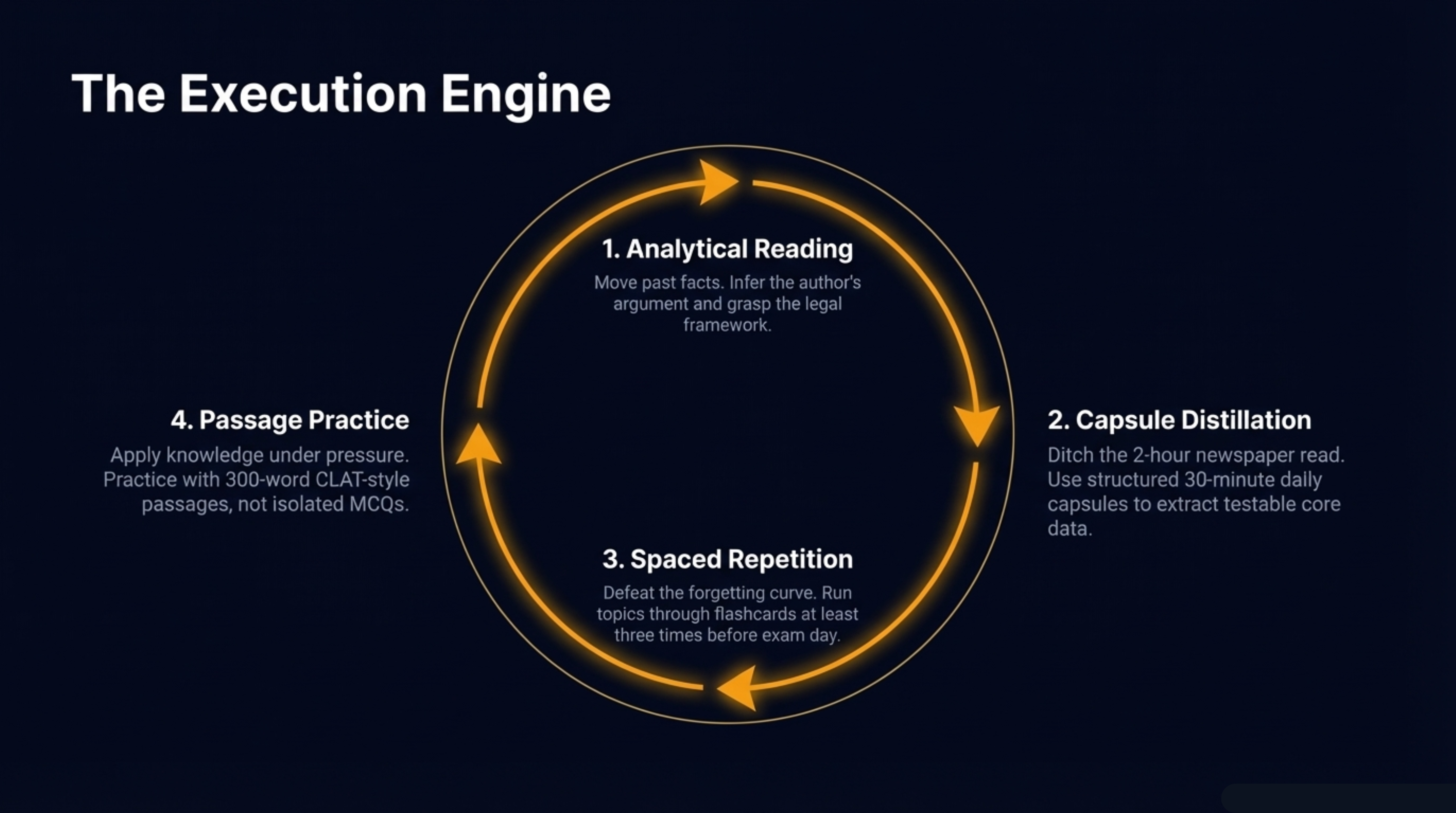
Read analytically, not just factually. CLAT doesn't ask "When was the BNS enacted?" It asks you to read a 300-word passage about the BNS and infer the author's argument. For every topic, understand the key arguments on both sides, the constitutional or legal framework involved, and the current status.
Use a capsule system. Spending 2 hours reading newspapers daily is inefficient. A structured GK capsule that distils each topic into its testable core — facts, legal angles, and arguments — saves time and improves retention. CLAT Tribe's GK Capsule is built exactly for this: 30 minutes a day, covering all 20 categories above.
Revise with flashcards. Current affairs has a forgetting curve problem. You read something in March, forget it by October. Spaced repetition through flashcards solves this. Review each topic at least three times before the exam.
Practice passage-based questions. Reading about a topic and answering questions on a passage about that topic are different skills. Practice with CLAT-style passages, not just MCQs.
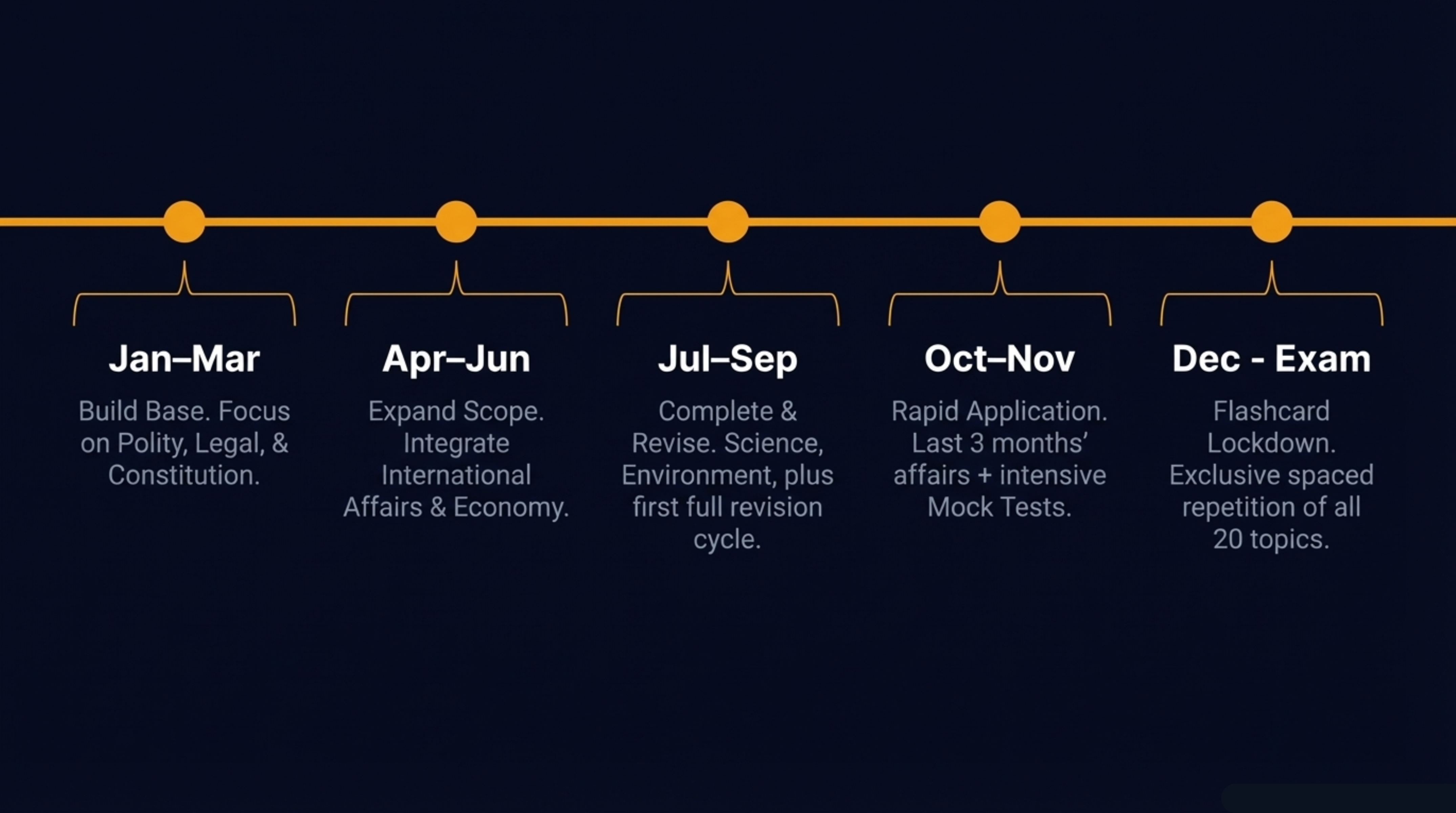
Month-Wise Coverage Strategy for CLAT 2027
| Month | Focus Area | Action |
|---|---|---|
| January–March 2027 | Build static GK base + start current affairs | Cover Topics 1, 2, 3, 8, 10 (legal/constitutional) |
| April–June 2027 | International affairs + economy | Cover Topics 4, 5, 6, 9, 11, 13, 17 |
| July–September 2027 | Science, tech, environment + revise all | Cover Topics 7, 12, 18 + revise earlier topics |
| October–November 2027 | Rapid revision + last 3 months' affairs | Cover Topics 14, 15, 16, 19, 20 + mock tests |
| December 2027 (exam month) | Flashcard-only revision | Review all 20 topics via CLAT Tribe flashcards |
FAQs
How many current affairs questions appear in CLAT?
The GK and Current Affairs section typically has 28–35 questions in CLAT, almost all passage-based since the 2020 format change. These questions carry 1 mark each with 0.25 negative marking, contributing roughly 25% of the total paper.
How far back should I study current affairs for CLAT 2027?
Cover at least 12–14 months before the expected exam date. If CLAT 2027 is held in December 2027, study from approximately October 2026 onwards. For landmark events (like the new criminal laws or the electoral bond judgment), go further back because their consequences are still unfolding.
Is static GK still important for CLAT 2027?
Static GK has reduced significantly since 2020, but it hasn't disappeared entirely. You'll still see passages that require background knowledge of the Constitution, international organisations, or historical context. The 20 topics above blend current affairs with the static GK framework needed to understand them.
What are the best sources for CLAT current affairs?
The Hindu and Indian Express are the primary source material for CLAT passages. For legal current affairs, LiveLaw and Bar & Bench provide excellent coverage. For a curated, exam-ready format, CLAT Tribe's daily GK capsules distil the most relevant stories into a 30-minute daily read.
Can I score well in CLAT GK with just 3 months of preparation?
It's possible to score 20+ out of 35 with focused 3-month preparation if you use a structured system. The key is prioritising the highest-probability topics (like the ones on this list) and using spaced repetition for retention. Students with 6+ months have the advantage of deeper coverage and more revision cycles.
How do I handle passage-based current affairs questions in CLAT?
Read the passage first, not the questions. Identify the author's main argument and any counter-arguments presented. CLAT questions often test whether you can distinguish what the passage says from what you know independently. Answer based on the passage, not your general knowledge — even if your knowledge differs from the passage's claims.
Which topics have appeared most frequently in recent CLAT papers?
Constitutional amendments, Supreme Court judgments, international conflicts, climate summits, and economic policy changes are the five most tested categories across CLAT 2022–2026. This list prioritises topics in these exact categories for CLAT 2027.
Should I study all 20 topics equally?
No. Prioritise based on the weightage table above. Indian Polity & Governance and International Affairs together account for 5–7 passages. Legal Developments get 2–3 passages. Allocate your preparation time proportionally.

Click here : clattribe.com/clat-2027-starter-kit
Conclusion
CLAT 2027's GK section won't reward students who read everything. It will reward students who read the right things, understand them deeply, and can navigate analytical passages under pressure.
These 20 topics represent the highest-probability content areas based on exam patterns, sustained media coverage, and legal relevance. Master them systematically — with daily capsules for intake, flashcards for retention, and passage practice for application — and you turn GK from a gamble into your strongest scoring section.
The aspirants who crack top NLU seats aren't necessarily smarter. They just prepare smarter. Ab tumhari baari hai.
Start with CLAT Tribe's free CLAT 2027 Starter Kit — daily GK capsules, flashcards, and passage practice → clattribe.com/clat-2027-starter-kit