Operation Sindoor — CLAT Current Affairs Guide
Operation Sindoor — CLAT Current Affairs Guide
Quick Reference
| Parameter | Detail |
|---|---|
| Launch Date | 7 May 2025 (night of 6–7 May) |
| Duration | ~23 minutes (strike) / ~87 hours (conflict) |
| Targets Hit | 9 terror sites (24 precision strikes) |
| Trigger | Pahalgam Terror Attack (22 April 2025) |
| Ceasefire | 10 May 2025, 5:00 PM IST |
01. Background — The Pahalgam Attack
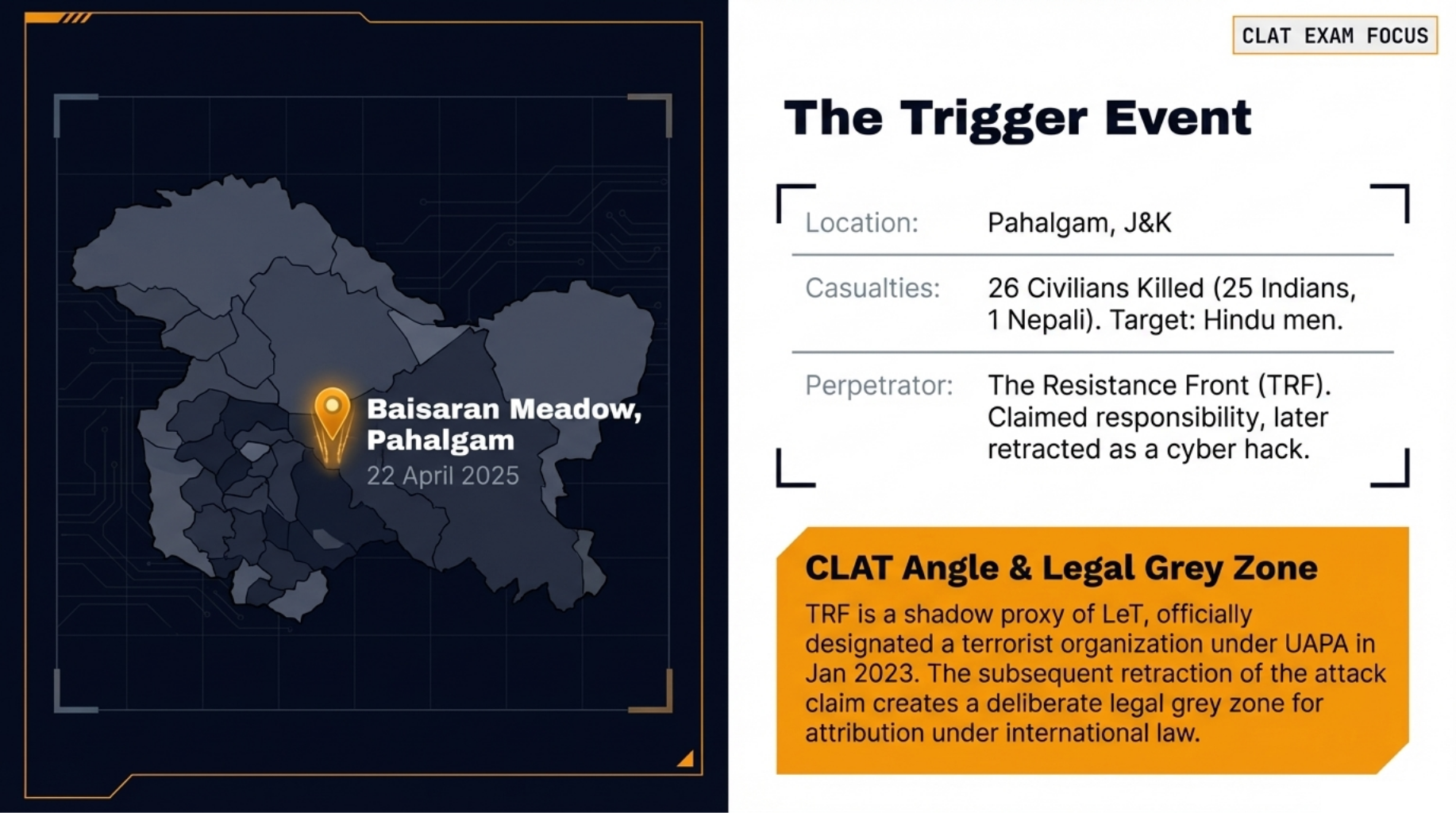
On 22 April 2025, armed terrorists struck the scenic Baisaran meadow near Pahalgam, Jammu & Kashmir. The attackers reportedly asked victims to recite the Quran before opening fire, a deliberate attempt to engineer communal violence. The attack killed 26 civilians (25 Indians + 1 Nepali national), making it one of the deadliest strikes on civilians in J&K in decades.
The Resistance Front (TRF) — a shadow proxy of the UN-designated Lashkar-e-Taiba (LeT) initially claimed responsibility, then retracted the claim calling it a "cyber hack."
CLAT Angle: TRF was designated a terrorist organisation by India under the Unlawful Activities (Prevention) Act (UAPA) in January 2023. The designation and retraction raise important legal dimensions around attribution of terrorist acts and state responsibility under international law.
Key Facts of the Attack
| Detail | Information |
|---|---|
| Location | Baisaran Meadow, Pahalgam, J&K |
| Casualties | 26 killed (25 Indians + 1 Nepali) |
| Claimed By | TRF (LeT proxy) — later retracted |
| UAPA Status of TRF | Designated terrorist org (Jan 2023) |
02. Operation Sindoor — The Strike
The night of 6-7 May 2025, the Indian Armed Forces carried out a tri-service precision strike on terrorist infrastructure in Pakistan and PoJK under the codename Operation Sindoor.
The Indian Armed Forces described the strike as a “focused, measured, and non-escalatory” action. There was no strike on Pakistani military assets in the initial phase. Only terrorist assets of Jaish-e-Mohammed (JeM), Lashkar-e-Taiba (LeT), and Hizbul Mujahideen (HuM) were targeted.
Why the Name "Sindoor"?
Sindoor is a red vermilion powder worn by married Hindu women. It is a symbol of marriage. The Pahalgam attack was aimed at Hindu men, thus making their wives widows. The name itself was a symbolic reference to the grief and determination of a nation.
Strike Details
| Detail | Information |
|---|---|
| Sites in PoJK | 5 locations |
| Sites in Pakistan proper | 4 locations (Punjab Province) |
| JeM HQ struck | Bahawalpur, Punjab Province |
| LeT HQ struck | Muridke, near Lahore |
| Press Briefing led by | Foreign Secretary Vikram Misri, Col. Sofiya Qureshi, Wg. Cdr. Vyomika Singh |
The strike was significant as it was the first time since the 1971 war that India had struck Punjab, which is Pakistan's most populous and economically important province.
03. Chronological Timeline
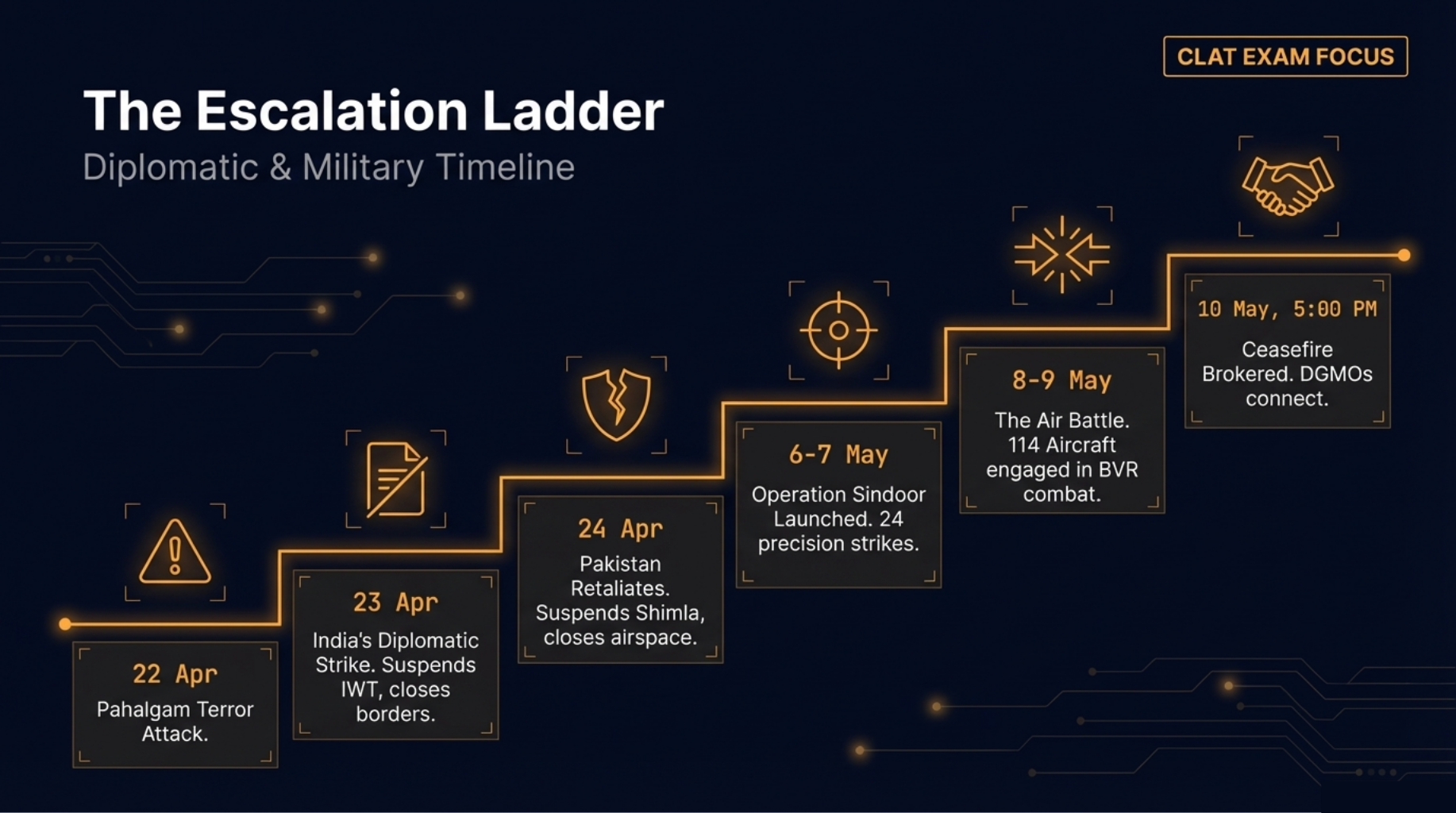
22 April 2025 Pahalgam Terror Attack
26 civilians killed near Baisaran meadow. TRF (LeT proxy) claims responsibility. PM Modi cuts short Saudi Arabia visit; Cabinet Committee on Security (CCS) meeting held.
23 April 2025 India's Diplomatic Response
Foreign Secretary Vikram Misri announces suspension of the Indus Waters Treaty (1960) "with immediate effect." India also closes the Attari-Wagah border post and expels Pakistani military advisers.
24 April 2025 Pakistan Retaliates Diplomatically
Pakistan suspends the Shimla Agreement (1972), closes airspace to Indian aircraft, expels Indian diplomats, bans Indian nationals, and halts all trade. Cross-border skirmishes begin along the LoC.
Night of 6–7 May 2025 Operation Sindoor Launched
India launches 24 precision strikes on 9 terror sites in Pakistan and PoJK. The operation lasts approximately 23 minutes. Over 100 militants reportedly killed.
8–9 May 2025 Pakistan Retaliates Militarily
Pakistan launches drone and missile attacks on Indian religious sites and civilian areas. India expands Operation Sindoor to target Pakistani military airfields. The resulting aerial engagement — 114 aircraft (72 IAF + 42 PAF) — became the world's largest Beyond Visual Range (BVR) air battle.
10 May 2025, 5:00 PM IST Ceasefire
Pakistan's DGMO calls Indian DGMO. Ceasefire announced; brokered with US mediation (President Trump claimed credit). Both sides allege subsequent violations.
04. Key Persons
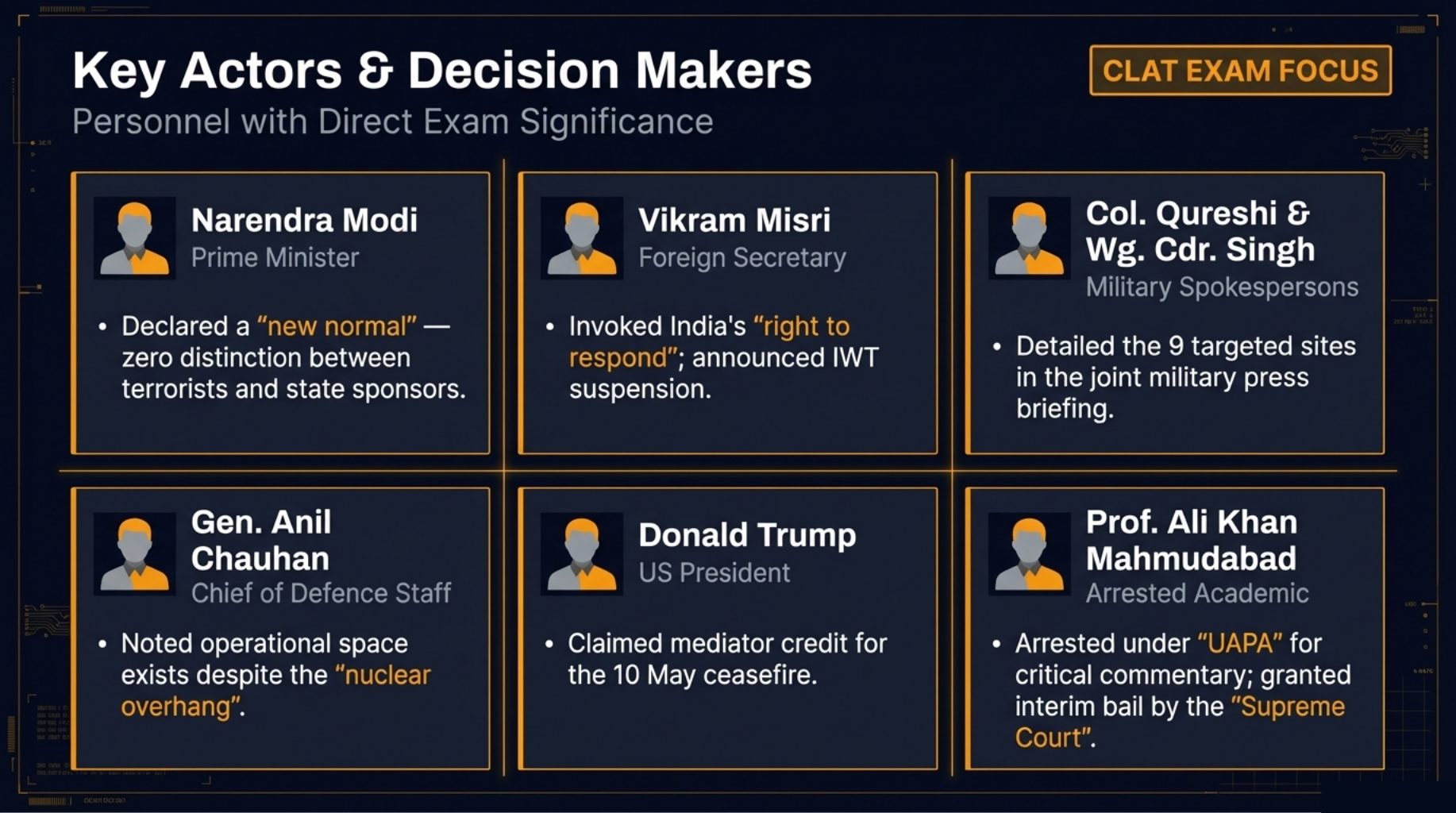
| Person | Position | Significance |
|---|---|---|
| Narendra Modi | Prime Minister of India | Called Op. Sindoor a "new normal," no distinction between terrorists and state sponsors |
| Rajnath Singh | Defence Minister of India | Announced over 100 terrorists killed; called 2025 "Year of Reforms" in MoD |
| Vikram Misri | Foreign Secretary of India | Conducted press briefing; announced suspension of IWT; invoked India's "right to respond" |
| Col. Sofiya Qureshi | Military Spokesperson | Provided details of 9 targeted locations in press briefing; her selection sparked controversy |
| Wg. Cdr. Vyomika Singh | Military Spokesperson | Accompanied Col. Qureshi in the press briefing |
| Gen. Anil Chauhan | Chief of Defence Staff | Commented on Op. Sindoor giving "significant space for conventional operations" despite nuclear deterrence |
| Donald Trump | US President (Mediator) | Took credit for the ceasefire; called the war a "bad nuclear war" if not stopped now |
| Prof. Ali Khan Mahmudabad | Academic (Controversy) | Arrested as an Ashoka University professor over social media comments; granted interim bail by Supreme Court of India |
05. Weapons & Technology Used
The Operation Sindoor was termed as "India’s First Non-Contact War"... no physical crossing of territorial boundaries. Strikes were conducted using long-range stand-off weaponry, and the use of "indigenously developed or assembled systems" was significant.
| System | Type | Origin | Key Significance |
|---|---|---|---|
| BrahMos | Supersonic Cruise Missile | India–Russia (Joint) | Air Launched from Su-30 MKI. Indigenous Integration done for ~₹80 crores compared to the $200M quoted by Russia |
| Akash SAM | Surface-to-Air Missile System | Indigenous (DRDO) | Neutralized Pakistani Drones and Missiles. One of the most important Air Defense Systems |
| S-400 Triumf | Long-range Air Defense System | Russia | Highly effective against the enemy. US objected citing CAATSA |
| Harop | Loitering Munition (Kamikaze Drone) | Israel | Precision strikes on radar and Air Defense Systems |
| Scalp / Storm Shadow | Air Launched Cruise Missile | France/UK | Used by Indian Air Force’s Rafale Jets |
| Spice Bomb Kits | Precision Guidance Munition | Israel | Dumb bombs converted to precision-guided bombs |
| Akashteer | Integrated Air Defense System | Indigenous | Coordinated Army and Indian Air Force Air Defense in Real-Time using IACCS |
| Rafale | 4.5 Gen Multi-Rôle Fighter | France | Carried Scalp Missiles, some allegedly shot down by Pakistani air defenses (questionable) |
CLAT Factoid: The procurement of S-400 from Russia by India sparked CAATSA (Countering America's Adversaries Through Sanctions Act) concerns. Despite US opposition to its retention, India refused to give up its S-400 assets, and it proved to be a game-changer in Op. Sindoor.
06. Legal & Constitutional Dimensions (CLAT Focus)
This section is the richest for the legal reasoning and legal awareness sections of the CLAT exam.
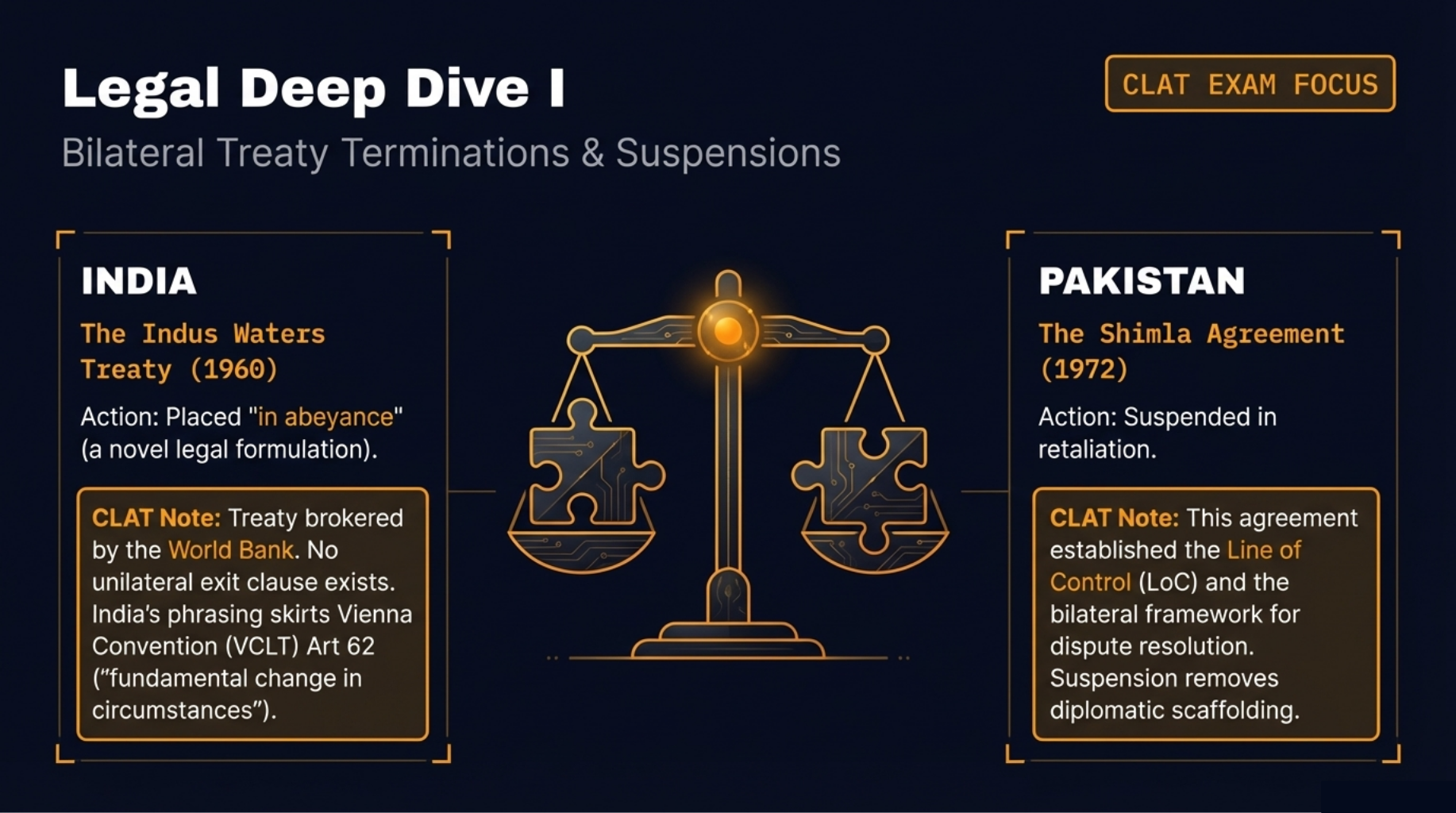
1. Indus Waters Treaty, 1960 - Suspension
India put the "IWT into abeyance," which is a new legal concept. Article XII of the IWT does not permit the suspension or withdrawal of the Treaty. The Vienna Convention on the Treaty of International Law (1969), which India has not ratified but which the Supreme Court has accepted as customary international law, allows the suspension of the Treaty under exceptional circumstances (Article 62 - "fundamental change of circumstances"). India’s position on the Treaty is in the realm of legal uncertainty.
The IWT divides the rivers as follows:
- Eastern Rivers (Sutlej, Beas, Ravi) → India
- Western Rivers (Indus, Jhelum, Chenab) → Pakistan
2. Shimla Agreement, 1972 - Suspended by Pakistan
Pakistan has suspended the Shimla Agreement as retaliation. This agreement established the Line of Control (LoC) as the "de facto boundary in the state of J&K and established the framework for the peaceful resolution of the dispute between India and Pakistan.
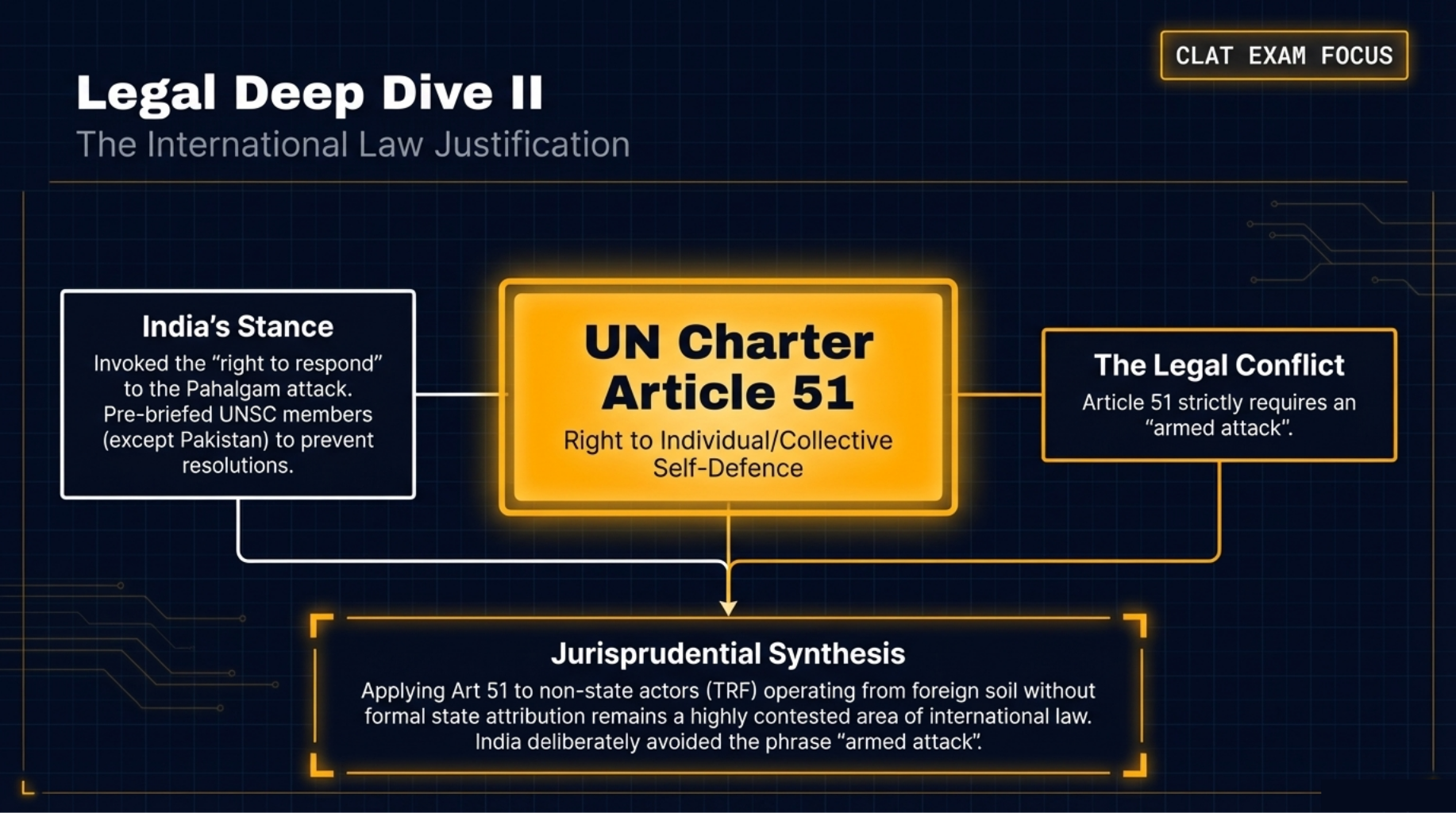
3. Right to Self-Defence – UN Charter, Article 51
The Foreign Secretary of India referred to India's "right to respond." This is an implicit reference to Article 51 of the UN Charter. At the same time, India has not explicitly referred to the attack in Pahalgam as an "armed attack." This is because, under international law, invoking self-defence against a non-state actor operating from foreign soil is questionable.
4. UAPA – Unlawful Activities (Prevention) Act
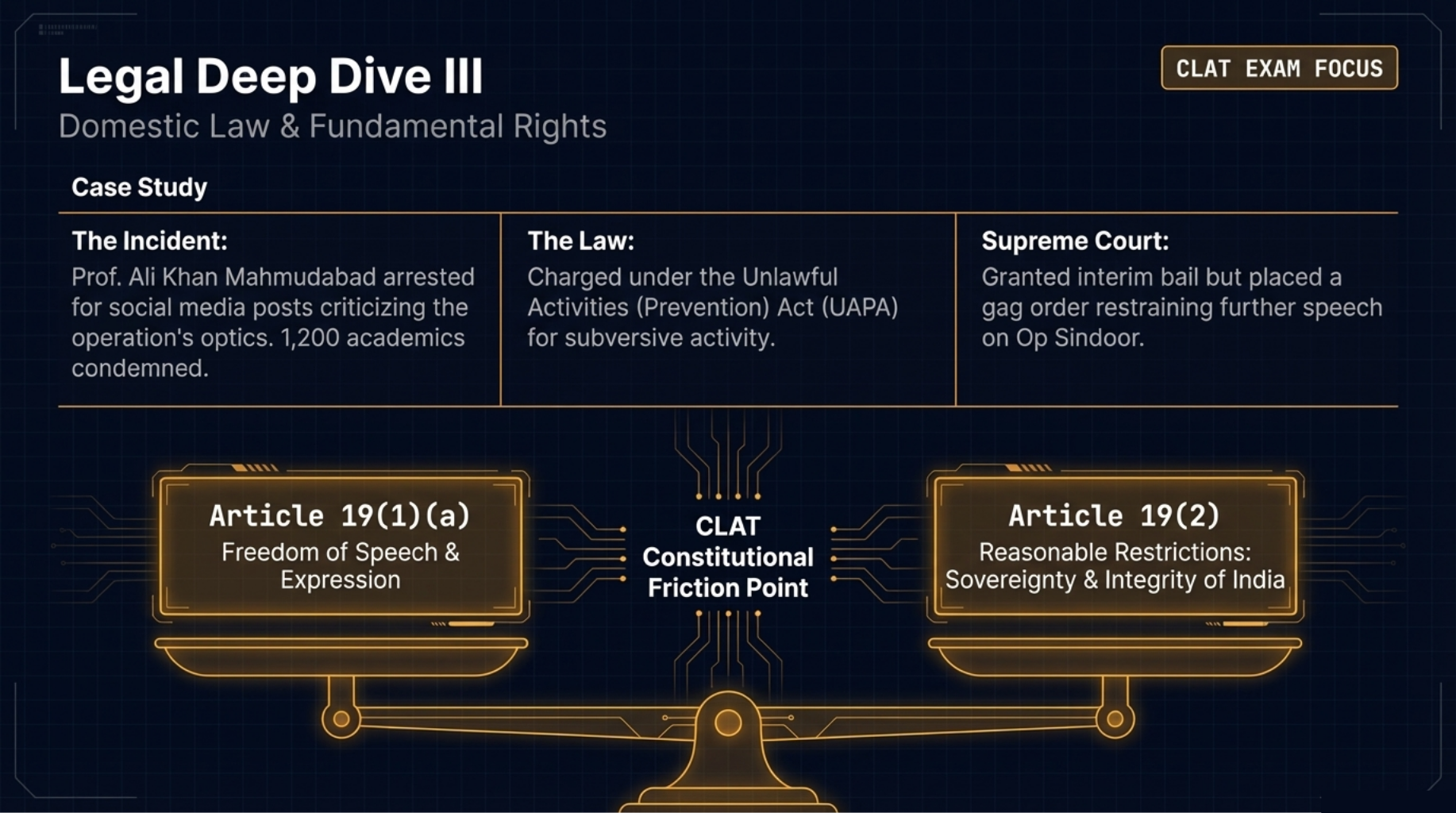
TRF has been declared an unlawful association under the UAPA. Professor Ali Khan Mahmudabad, an academic at Ashoka University, was detained under sections dealing with communal disharmony and subversive activities due to his social media posts criticizing Op. Sindoor. Professor Ali was granted interim bail by the Supreme Court of India. At the same time, he was restrained from commenting on Op. Sindoor and the attack in Pahalgam.
5. FATF – Financial Action Task Force
India pushed hard for Pakistan's inclusion in the Financial Action Task Force grey list. The FATF is an inter-governmental organization that monitors countries with strategic weaknesses in fighting money laundering and financing terrorism. Pakistan was in the grey list from 2018 to 2022.
CLAT Legal Reasoning – Must-Know Points
- The IWT was facilitated by the World Bank in 1960. Unilateral suspension is not provided for in the treaty.
- "In abeyance" is a legal concept different from suspension or withdrawal. There is no such concept in the VCLT.
- The right to self-defence under the UN Charter in Article 51 is valid only when there is an "armed attack." The involvement of non-state actors creates a problem.
- The Supreme Court releasing Prof. Mahmudabad on bail and restricting his speech raises the issue of the balance between Article 19(1)(a) (freedom of speech) and Article 19(2) (reasonable restrictions).
- There was no UNSC resolution against India because India had briefed all UNSC members except Pakistan.
07. Strategic Significance
Operation Sindoor marks a paradigm shift in India's national security doctrine, as it ended the tradition of strategic restraint that had been India's response to cross-border terrorism since the 1990s.
| Dimension | Significance |
|---|---|
| Doctrinal Shift | "New Normal" — No distinction between terrorists and state sponsors of terrorism |
| Nuclear Overhang | India maintained its No-First-Use (NFU) policy; Pakistan's implicit nuclear blackmail was called and defied |
| Atmanirbhar Bharat | Indigenous capabilities like BrahMos, Akash, Akash Teer — validation in actual combat scenarios |
| Military Asymmetry | First time Indian military superiority over Pakistan has been established since 1971 |
| India-China Dimension | Ineffectiveness of air defenses supplied by China to Pakistan; raises a question mark over China's credibility as an arms exporter |
08. Practice MCQs for CLAT
10 questions covering GK, Legal Awareness, and Current Affairs dimensions of Operation Sindoor.
Q1. Operation Sindoor was launched by India on which date?
- A) 22 April 2025
- B) 7 May 2025 ✅
- C) 10 May 2025
- D) 23 April 2025
Explanation: Operation Sindoor was launched on the night of 6–7 May 2025. 22 April was the Pahalgam attack; 23 April was the IWT suspension; 10 May was the ceasefire date.
Q2. The name "Sindoor" for the operation symbolises which of the following?
- A) India's red-coloured military insignia
- B) The red alert status declared by India
- C) The vermilion worn by married Hindu women, whose husbands were targeted at Pahalgam ✅
- D) A codename randomly assigned by the Indian Army
Explanation: The Pahalgam attackers specifically targeted Hindu men, widowing their wives. Sindoor — the vermilion mark of a married Hindu woman — was chosen to reflect national grief and resolve. Symbolic naming is a recurring theme in CLAT GK questions.
Q3. The Indus Waters Treaty (1960) was brokered by which international organisation?
- A) United Nations
- B) World Bank ✅
- C) International Court of Justice
- D) SAARC Secretariat
Explanation: The IWT of 1960 was facilitated by the World Bank. It divided the six rivers of the Indus system between India and Pakistan.
Q4. Under which Indian law was The Resistance Front (TRF) designated as a terrorist organisation?
- A) National Security Act, 1980
- B) Prevention of Terrorism Act, 2002
- C) Unlawful Activities (Prevention) Act (UAPA) ✅
- D) Arms Act, 1959
Explanation: TRF was designated under UAPA in January 2023. UAPA is a key statute in CLAT legal awareness — it deals with activities directed against the sovereignty and integrity of India.
Q5. Which bilateral agreement did Pakistan suspend in retaliation to India's post-Pahalgam measures?
- A) Tashkent Declaration, 1966
- B) Shimla Agreement, 1972 ✅
- C) Lahore Declaration, 1999
- D) Karachi Agreement, 1949
Explanation: Pakistan suspended the Shimla Agreement of 1972, which established the Line of Control (LoC) and provided the bilateral framework for India-Pakistan dispute resolution. The Tashkent Declaration ended the 1965 war; the Lahore Declaration was a 1999 peace effort; the Karachi Agreement defined the ceasefire line after the 1947 war.
Q6. The BrahMos missile used in Operation Sindoor is a joint development between India and which country?
- A) USA
- B) Israel
- C) Russia ✅
- D) France
Explanation: BrahMos is a supersonic cruise missile jointly developed by India (DRDO) and Russia (NPO Mashinostroyenia). The name combines "Brahmaputra" and "Moskva" rivers. Its integration with the Su-30 MKI was done indigenously for ~₹80 crore — far cheaper than the $200M quoted by Russia.
Q7. Which Article of the UN Charter is relevant to India's claimed "right to respond" to the Pahalgam attack?
- A) Article 2(4)
- B) Article 39
- C) Article 51 ✅
- D) Article 94
Explanation: Article 51 of the UN Charter preserves the inherent right of individual or collective self-defence in response to an armed attack. India invoked this implicitly to justify Operation Sindoor. Article 2(4) prohibits use of force; Article 39 deals with threats to peace; Article 94 deals with ICJ judgements.
Q8. Operation Sindoor was India's most significant strike on Pakistani territory since which war?
- A) 1947–48 Kashmir War
- B) 1965 Indo-Pakistani War
- C) 1971 Bangladesh Liberation War ✅
- D) 1999 Kargil War
Explanation: Multiple experts described Operation Sindoor as the deepest military strike by India on Pakistani targets since the 1971 Bangladesh Liberation War. It also marked the first time since 1971 that India struck Pakistani Punjab.
Q9. Prof. Ali Khan Mahmudabad was granted interim bail by which court following his arrest related to Operation Sindoor commentary?
- A) High Court of Delhi
- B) National Security Tribunal
- C) Supreme Court of India ✅
- D) Sessions Court, Haryana
Explanation: Prof. Mahmudabad of Ashoka University was arrested for social media posts questioning the use of Muslim officer Col. Sofiya Qureshi as "optics." Over 1,200 academics condemned the arrest. He was granted interim bail by the Supreme Court of India, which also restrained him from commenting further on the operation.
Q10. Which of the following correctly describes FATF and India's use of it against Pakistan post-Op. Sindoor?
- A) FATF is a UN body; India expelled Pakistan from it
- B) FATF is a World Bank mechanism; India froze Pakistan's loans
- C) FATF monitors terrorist financing; India pursued Pakistan's re-inclusion in the FATF grey list as a punitive measure ✅
- D) FATF is part of the SAARC charter; India suspended Pakistan's membership
Explanation: The Financial Action Task Force (FATF) is an intergovernmental body setting standards against money laundering and terrorist financing. Countries on the grey list face increased scrutiny. Pakistan was previously grey-listed from 2018–2022. India pursued its re-listing as a non-military punitive measure alongside the IWT suspension.
For Educational Use Only · CLAT Current Affairs · Operation Sindoor · May 2025